
Acoustics
Clear answers on underwater acoustics to monitor and characterize sound and mitigate noise effects on marine life.
From characterizing and localizing acoustic sources in the ocean, to understanding how noise from your project could affect marine life, our in-house experts have it covered. As leaders in underwater and terrestrial acoustics, we translate complex acoustical science into clear answers, defensible assessments, and practical mitigation strategies that keep your project moving forward.
Acoustics Team
Kaustubha Raghukumar, Ph.D. Senior Consultant
Kerri D. Seger, Ph.D. Consultant
Alex Loureiro, Ph.D. Senior Consultant
Featured Projects
Listening to the Deep: Advancing Ocean Soundscape Monitoring with Autonomous Acoustic Technology
Optical Detection of Ensonified Ocean Waves
Biological Monitoring of Coastal Fireworks Display
Detection, Classification, and Localization in Three Dimensions
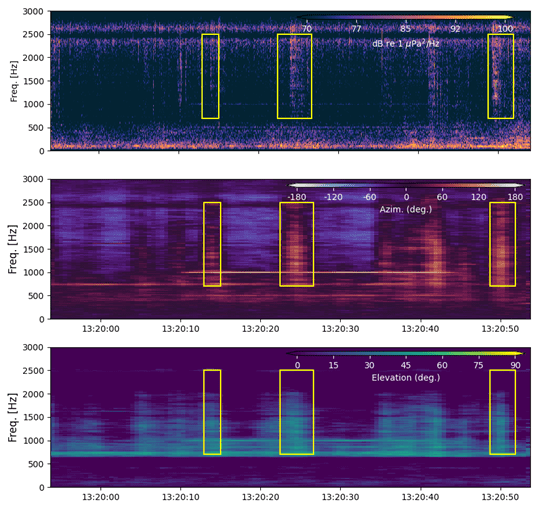
Know exactly what’s happening when and where and for how long in your acoustic environment. Our proprietary NoiseSpotter® technology detects, classifies, and locates underwater sound sources in near real time from a single compact array. While most monitoring requires multiple devices to determine where sounds originate, we can localize and track multiple sources at once with one system, reducing equipment costs while providing superior domain awareness.
What You Get:
- Real-time detection and tracking of vessels, unmanned underwater vehicles, marine mammals, and other sound sources
- Source localization that pinpoints where sounds come from, not just that they are nearby
- Species-specific detection algorithms built from over two decades of cataloguing marine animal vocalizations
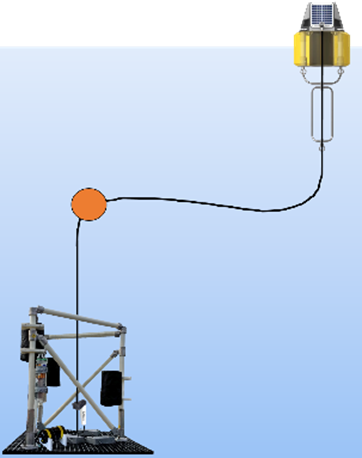
NoiseSpotter
NoiseSpotter® (U.S. patent 11,156,734) is the first state-of-the-art commercial vector sensor array that measures and locates underwater sound sources in near real time.
Noise Impact Assessment & Compliance
Regulators want defensible science showing your project won’t harm marine life. We characterize the reach of noise throughout a construction site in three dimensions and predict animal responses to that noise with custom movement models. How we calculate takes of sensitive species is based on the most current science for aural thresholds – thresholds we are actively refining with current impact assessment studies. Our experience includes permitting some of the loudest sounds in the ocean, giving us unmatched insight into what agencies expect.
What You Get:
- Rigorous assessments that demonstrate compliance with MMPA, ESA, and international requirements
- Mitigation strategies designed around your operational realities
- Clear documentation that facilitates permit approval
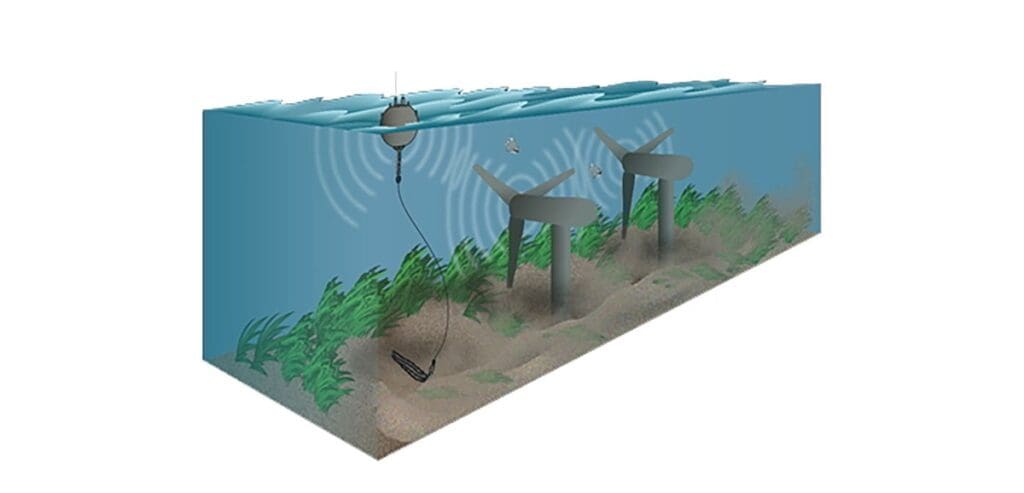
Acoustic Propagation Modeling
Understand how sound from your operations will travel through complex environments before you begin work. Our modeling expertise spans shallow coastal waters to deep ocean basins, using industry-standard tools that are constantly validated against extensive field measurements.
What You Get:
- Baseline soundscape characterization and exclusion zone determination
- Propagation modeling (ray-tracing, normal modes, parabolic equation models) matched to your site conditions
- Source field characterization and range determination to critical thresholds
FAQs
If your project involves pile driving, dredging, seismic surveys, offshore construction, or significant activity near protected species habitat, regulators will likely require acoustics as part of the environmental impact assessment. Early engagement helps you design operations that avoid costly delays.
Most consultants use omni-directional recorders that detect sounds but can’t determine where they come from. Our NoiseSpotter also provides directional sensing with a single device, meaning we can pinpoint the direction a sound is coming from and filter out sounds from other directions. We can home in on your sound of choice, producing more accurate measurements about its intensity, at a lower cost than an entire array. We also bring deep bioacoustics expertise, including hosting the global humpback whale social call catalogue, so we understand not just the physics of sound but can contextualize how animals use and respond to it.
NoiseSpotter® is our proprietary vector sensor array that measures and locates underwater sound sources in near real time. Developed with Sandia National Laboratories, it provides both pressure and particle motion data from a compact system (1 x 1 x 1.25 m), reducing equipment costs while delivering source localization and real-time data telemetry.
We use both published thresholds for hearing impairment and behavioral responses and implement Before-After Control-Impact (BACI) methodology with visual and acoustical methods. Therefore, we can both predict which animals will have their hearing or behaviors affected at various distances from noise sources, and drive basic research that measures animal behavior and acoustic activity before, during, and after noise-producing events. This provides defensible data showing actual effects rather than relying on theoretical predictions alone.
Our primary expertise is underwater, but we also have experience conducting terrestrial wildlife acoustic monitoring. For example, we’ve conducted bat acoustic surveys during fireworks displays and have measured differences in bird songs between urban and rural environments.