
Optical Detection of Ensonified Ocean Waves
Project Summary
The Office of Naval Research engaged Integral to investigate whether underwater acoustic waves could be detected by observing their surface signatures from above water. Integral designed and executed two field experiments on Seneca Lake, NY, using a polarimetric camera to measure nanometer-scale capillary waves induced by submerged acoustic sources. The project demonstrated, for the first time in a field setting, that continuous modulation of the ocean surface by underwater sound can be optically detected—offering potential applications in airborne detection of underwater vessels.
Key Personnel
Kaustubha Raghukumar, Ph.D. Senior Consultant
Frank W. Spada Senior Scientist
Grace Chang, Ph.D. Senior Science Advisor, Director of Research and Development
Challenge
Mapping the seafloor from the air requires understanding how underwater sound interacts with the ocean surface—a phenomenon that had never been demonstrated outside a laboratory.
The Office of Naval Research sought to advance the science of airborne seafloor mapping, which would offer a far faster alternative to conventional in-situ survey methods. The critical first step was determining whether the surface expression of underwater acoustic energy could be detected at all. The challenge was significant: underwater sound generates capillary waves with heights on the order of nanometers—too small to observe with standard optical instruments. Detecting these waves required both specialized equipment and novel analytical methods capable of resolving minute surface slope variations in open-water conditions.
Our Role
Integral provided underwater acoustics and optical sensing expertise, designed the field experiments, and led the theoretical analysis to explain observed phenomena.
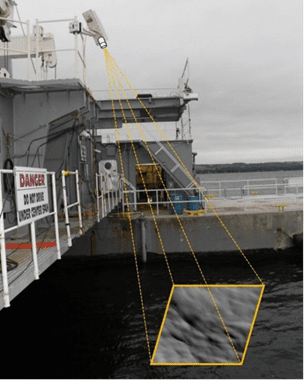
Integral identified an appropriate teaming partner in Lamont-Doherty Earth Observatory and developed the experimental framework for detecting ensonified wave signatures in a field environment. Our team applied a polarimetric camera—a technique that infers wave slopes from the polarization state of reflected light—in a novel configuration mounted on the Navy’s Stable Measurement Platform (SMP) on Seneca Lake. Unlike prior studies that relied on laser Doppler velocimeters constrained to laboratory settings, Integral’s approach was designed from the outset to be scalable to open-ocean conditions. The team conducted two field experiments over the course of the project, measuring both ambient and ensonified surface conditions using the camera and a Sofar Spotter wave buoy.
Schematic of experimental setup (Top). (Bottom) Polarimetric camera mounted to the SMP and pointed down at lake surface on Seneca Lake. (Photo courtesy NAVSEA Seneca Lake).
What We Delivered & Results
Integral achieved the first field demonstration of continuous optical detection of surface capillary waves induced by underwater acoustic sources, with results that exceeded client expectations.
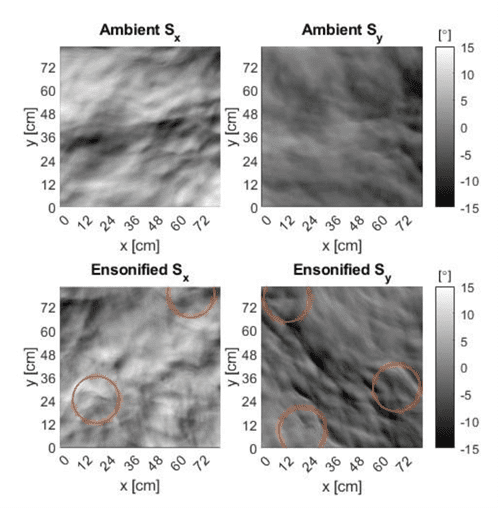
The field experiments produced direct measurements of nanometer-scale wave slope modulations associated with acoustic ensonification—a result previously achieved only under controlled laboratory conditions. Key outcomes include:
- Demonstrated continuous modulation of the water surface by underwater acoustic waves in a real-world field setting
- Confirmed that a polarimetric camera mounted on a stable naval platform can resolve the acoustic surface signature in ambient open-water noise conditions
- Identified promising applications beyond seafloor mapping, including detection of underwater sound-producing objects such as unmanned underwater vehicles (UUVs) and submarines from the air
- Findings presented at international conferences; a peer-reviewed publication is currently in review
The ability to detect underwater acoustic sources from the air could offer substantial time and cost savings compared to current methods, which rely on air-dropped sonobuoys or fixed underwater acoustic sensing networks. Program Manager Dr. Reggie Beach of the Office of Naval Research noted that the team’s efforts and results exceeded his expectations and described the work as professionally executed.

Project Highlights
- 3-year research program: Funded by Office of Naval Research
- Nanometer-Scale Detection: Capillary wave heights measured in the field
- First Field Demonstration: Polarimetric imaging of an ensonified ocean surface