
Biological Monitoring of Coastal Fireworks Display
Project Summary
The City of Capitola needed to understand how their annual Monte Foundation Firework Extravaganza, launched from an ocean pier within the Monterey Bay National Marine Sanctuary, affects local wildlife. Integral deployed a comprehensive monitoring approach combining visual surveys, thermal imaging, and acoustic recording to assess wildlife presence and behavior before, during, and after the event under Monterey Bay National Marine Sanctuary Authorization No. MBNMS-2025-015.
Key Personnel
Greg Cotten Senior Scientist
Kerri D. Seger, Ph.D. Consultant
Amy Howk Consultant
Challenge
Coastal communities across the country face growing questions about whether fireworks displays cause significant harm to marine and coastal wildlife.
The City of Capitola wanted data-driven answers about their annual fireworks event’s impact on wildlife in the Monterey Bay National Marine Sanctuary. Standard visual monitoring alone has limitations—nocturnal species like bats are difficult to observe in low-light conditions, and brief surveys may miss subtle behavioral changes that indicate stress or disruption.
The timing constraints inherent to before-after control-impact (BACI) study design meant that all recording equipment and observers needed to be positioned precisely for the event—missing those data collection windows would undermine the study’s validity. Surveys also needed to occur at similar tidal conditions to ensure valid comparisons.
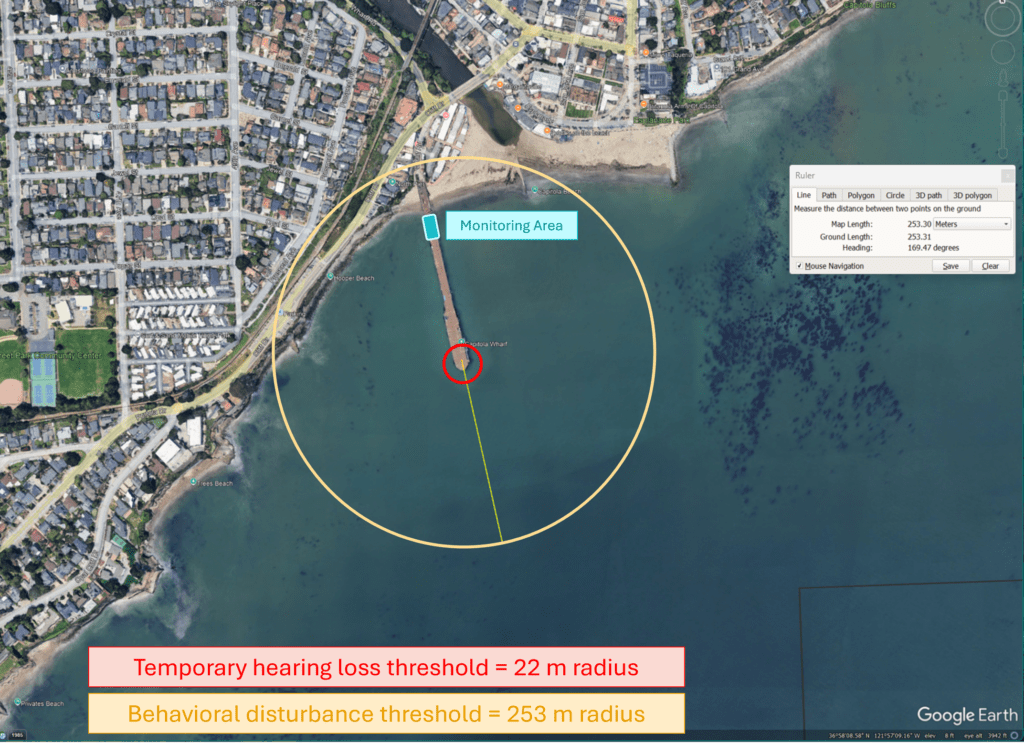
Study area showing the modeled 253-meter behavioral disturbance threshold and 22-meter temporary hearing loss threshold for pinnipeds around the fireworks launch point.
Our Role
Integral designed and implemented a multi-method monitoring program combining visual, thermal, and acoustic approaches to capture a complete picture of wildlife response across marine mammals, seabirds, and terrestrial species.
Our team deployed a Wildlife Acoustic Song Meter SM4 on the wharf one week before the event to establish baseline data, with continuous recording at a 96 kHz sampling rate to capture bat echolocation frequencies. The day before the fireworks, biologists conducted walking transect surveys along the beach within 0.5 mile of the detonation area to document any animals that had washed ashore or perished from unrelated causes, following Monterey Bay National Marine Sanctuary Wildlife Survey Guidelines.
On the event day, we monitored wildlife using thermal cameras and binoculars to observe and document how animals in and around the pier area responded to the display—whether they moved, flushed, or showed other behavioral changes. The City approved a vantage point on the wharf above the beach, providing optimal viewing to the east and west while prioritizing the highest potential impact zone immediately around the firework launch area. Post-event surveys repeated the beach transects the following morning at the lowest daylight tide within 24 hours of the event.
This year marked the first time acoustic monitoring was added to the program, expanding our ability to detect species that are difficult to observe visually at night and enabling quantitative analysis of behavioral changes.
What We Delivered & Results
Our monitoring confirmed no wildlife mortalities or injuries from the fireworks, documented minimal impact on marine mammals, and quantified temporary but measurable effects on bat foraging behavior.
Marine mammals: Except for one otter, no marine mammals were observed within the temporary hearing-loss threshold radius (22 m) nor the behavioral disturbance threshold radius (253 m) during the event. In the kelp bed approximately 300 m to the east, marine mammal behavior appeared unaffected—an otter displayed feeding behavior 200 m from the fireworks launch area. A humpback whale off New Brighton State Beach, roughly 1 mile away, was observed feeding before, during, and after the display. No mammals appeared to move or flush in response to the fireworks.
Seabirds: Birds on the wharf flushed during the soft start, and seabirds were observed clearing the immediate area. However, some pelicans remained resting in the water approximately 122 m from the launch point, and roosting pigeons remained under the wharf throughout the show. Bird activity around the wharf returned to normal by the following morning.
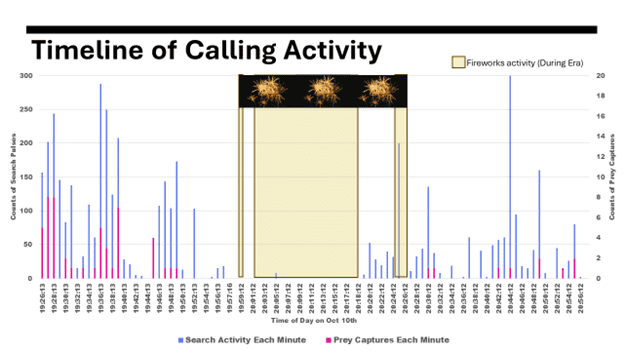
Bats: Acoustic analysis of big brown bat (Eptesicus fuscus) echolocation calls revealed the most detailed behavioral data:
- Prey searching occurred over 80% less often during fireworks compared to before
- Successful prey capture completely stopped during the 31-minute firework show
- After the fireworks ended, searching resumed by over 200% compared to during the show, but prey capture occurred 80% less often than pre-event baseline
- Bats took approximately 5 minutes to recover search efforts after the show ended
Mortality assessment: No animals were observed to have died or sustained injury from the fireworks. Two deceased birds found the morning after the event (a common murre and a cormorant) both appeared deceased for more than 24 hours based on decomposition state and showed no obvious signs of trauma.
The comprehensive report provided the city with evidence that the fireworks did not cause direct wildlife mortality, had little to no effect on marine mammals, and produced temporary localized effects on flying animals—data that contribute to the broader scientific understanding of fireworks effects on coastal wildlife and supports informed decision-making about future events.
Bat echolocation activity before, during, and after the fireworks display. Blue bars show prey-searching pulses; pink bars show successful prey captures. The yellow shaded area indicates fireworks activity. Searching dropped by 85% during the display, and prey capture ceased entirely.
Project Highlights
- Location: Capitola Pier, Monterey Bay National Marine Sanctuary
- Monitoring Methods: Visual transect surveys, thermal imaging, acoustic recording (Wildlife Acoustic Song Meter SM4), BACI analysis
- Species Documented: Big brown bats (Eptesicus fuscus), sea otters, sea lions, humpback whale, pelicans, cormorants, gulls