
Ecological Risk Assessment
Assess, manage, and mitigate ecological risks associated with ingredients, products, sites, and practices.
Take control of ecological risks before they threaten your project timeline, regulatory standing, or bottom line. Our deep understanding of ecology and toxicology guides clients through complex environmental challenges with scientifically rigorous, tailored strategies that simultaneously address regulatory requirements and business needs.
Ecological Risk Assessment Experts
Damian V. Preziosi Managing Principal, Strategic Initiatives Director
Miranda Henning, BCES Managing Principal, Business Director - Health and Ecology
Judi L. Durda Senior Principal
Jen Lyndall, CERP, CSE Principal
Heather M. Summers Senior Consultant
Maryann Welsch Senior Consultant
Knowledge Share
Achieving Fair Cost Allocation in Complex Superfund Litigation
Defending Against State PCB Contamination Claims
Strategic Investigation of New Jersey's Berry's Creek Superfund Site
Ecological risk assessment of per‐ and polyfluorinated alkyl substances: Foreword
Ecological Risk Analysis for Benzalkonium Chloride, Benzethonium Chloride, and Chloroxylenol in U.S. Disinfecting and Sanitizing Products
Aquatic Risk of Fragrance Materials: Advancing Prioritization in Aquatic Systems
With extensive experience internationally and throughout the U.S., we deliver the technical depth to navigate complex negotiations and, when necessary, defend our science in court.
Decision-making Tool for Site Remediation
We design ecological risk assessments that directly inform remediation decisions, rather than simply serving as a compliance checkbox. Our approach begins with understanding how the assessment will guide your cleanup strategy, then scales our methods to match the project’s needs and site-specific conditions.
Key Capabilities:
- Conceptual site models that clarify actual exposure pathways and risk drivers
- Targeted study designs that focus resources on decision-critical data gaps
- Exposure modeling tailored to site-specific chemical and biological conditions
- Risk characterization that translates complex science into clear remediation strategies
Litigation Support
When facing claims related to natural resource injuries, causation, take, ecological risk, or allocation, you need technically robust analyses that withstand legal scrutiny. Our team combines deep expertise in ecology, toxicology, modeling, and statistics to evaluate such claims based on multiple lines of evidence and develop defensible risk assessments and causal assessments.
Specialized Services:
- Strategic risk assessment design, execution, and communication
- Systematic review of published research
- Expert ecotoxicology study design and oversight
- Weight-of-evidence analysis
- Comprehensive causal assessments
- Site-specific biological surveys, ecotoxicity bioassays, bioaccumulation studies, and ecological risk assessment

Product and Drug Registration
Regulatory approval for new products and drugs requires innovative and efficient environmental exposure and risk analyses. We provide the regulatory strategy and technical excellence needed to navigate complex approval pathways.
Regulatory Expertise:
- New drug application support with integrated environmental assessment strategies
- Study oversight that ensures data quality while controlling costs and timelines
- Regulatory compliance guidance across EPA, FDA, and international frameworks
- Strategic approach selection that optimizes approval probability while minimizing testing requirements

Environmental Product Stewardship
Consumer and industrial products and ingredients face growing scrutiny over environmental impacts throughout their lifecycles. We help you proactively assess and manage environmental exposures and ecotoxicity concerns before they become regulatory or market liabilities, using cutting-edge exposure assessment and effects modeling.
Stewardship Solutions:
- Down-the-drain exposure modeling for products and ingredients ultimately entering surface water bodies
- Tiered risk screening that efficiently prioritizes assessment needs
- New approach methodologies (NAMs) that reduce animal testing while maintaining scientific rigor
- Lifecycle risk assessment that anticipates future regulatory requirements

FAQs
Ecological risk assessment becomes essential when you’re facing regulatory requirements for contaminated sites, developing products with environmental release potential, or defending against claims that a chemical harmed fish, wildlife, or habitats. We help you navigate these challenges strategically, focusing assessment resources where they’ll have the greatest impact on regulatory and legal outcomes.
We begin with the end in mind—understanding how your risk assessment will be used for decision-making, rather than treating it as a box-checking exercise. This strategic focus allows us to tailor our methods and scale our analyses to your specific needs, delivering actionable insights that do not require a Ph.D. to understand.
Our assessments provide clear, defensible answers to your key questions: Which risks require action? How much remediation and which remediation technologies will be ecologically protective? How strong is the scientific evidence? What contributes the most uncertainty to the conclusions and how can we address those uncertainties cost-effectively? If there is evidence of ecological impairment, what was the most likely cause of that impairment? We package complex science into understandable recommendations that support practical business decisions and regulatory interactions.
We know the guidance and have invested decades into developing trusting relationships with diverse stakeholders. Our team includes scientists who helped develop state- and federal guidance for conducting ecological risk assessments, and who trained regulators in the review of ecological risk assessments. We use established frameworks, while incorporating the latest scientific advances and communicating clearly.
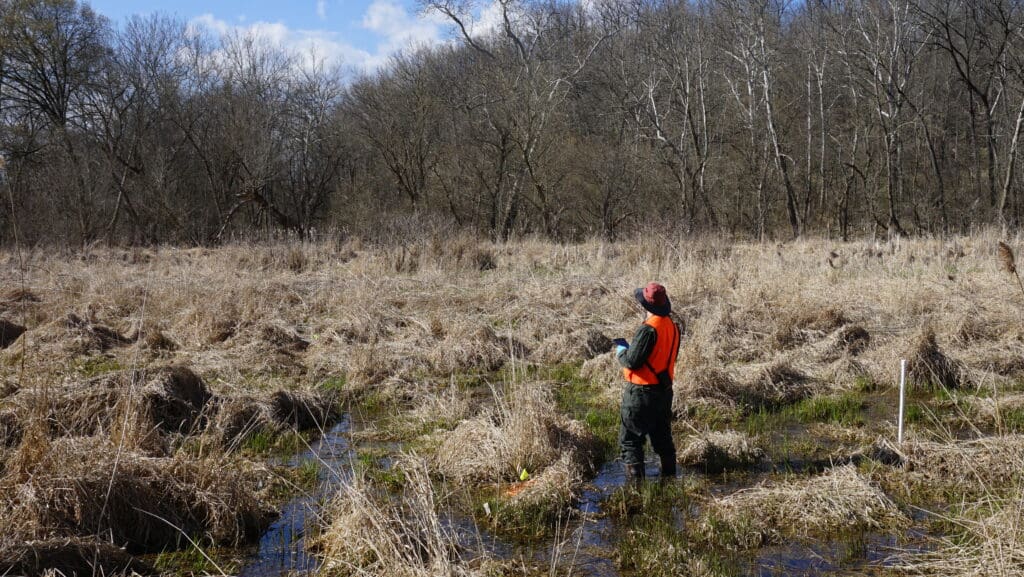
We begin by visiting the sites we are assessing and photo–documenting conditions. From there, we build an accurate conceptual site model, before defining all of the assumptions required for the risk assessment. Along the way, we engage with stakeholders to help us understand their concerns and to structure the risk assessment accordingly.
Our deep understanding of the underlying science allows us to propose approaches that maintain regulatory acceptability while reducing uncertainty, unnecessary costs and project delays. Finally, we both listen closely and communicate clearly.
We collaborate seamlessly across disciplines, integrating our risk assessment expertise with colleagues focused on investigation, remediation, and data management and analysis. Our multidisciplinary approach ensures your risk assessment supports comprehensive environmental strategies rather than operating in isolation.