
Transforming Community Opposition Through Surf Science: Topanga Lagoon Restoration Project
Project Summary
The first quantitative surf quality impact assessment turns 65% community opposition into project support through innovative wave modeling and stakeholder engagement.
When the Topanga Lagoon Restoration Project faced fierce opposition from the surfing community, the Resource Conservation District of the Santa Monica Mountains needed scientific proof that restoration wouldn’t destroy what surfers had cherished for generations. Integral developed the world’s first quantitative surf quality impact assessment, combining advanced wave modeling with community knowledge to demonstrate no long-term impacts on surf quality, transforming opposition into support and enabling successful environmental review.
Location: Topanga, California, USA
Key Personnel
David L. Revell, Ph.D. Principal, Coastal Climate Risk and Resilience
Challenge
When passionate surfers fear losing their waves, technical proof becomes the only path to project approval.
The Resource Conservation District of the Santa Monica Mountains, California State Parks, County of Los Angeles, and Caltrans faced a critical challenge: restoring the ecologically important Topanga Lagoon while addressing intense surfing community opposition. The stakes were high:
- 65.33% of surfers believed the project would decrease overall surf quality
- 62.16% expected fewer surfable days after restoration
- No established scientific methodology existed to assess surf break impacts
- Community opposition threatened to derail this crucial environmental restoration project
- Regulatory approval required addressing recreational impact concerns with technical evidence
Without a way to scientifically evaluate surf quality impacts, the project risked indefinite delays or cancellation, leaving both ecological restoration and community concerns unresolved.
Our Role
Integral pioneered surf science methodology, combining wave physics with community knowledge to provide the technical foundation for informed decision-making.
Our multidisciplinary team developed an innovative approach that treated surf quality assessment with the same scientific rigor applied to other environmental impact studies:
- Created the first quantitative methodology for evaluating surf break quality impacts
- Conducted community-driven research through surf focus group surveys to identify optimal wave conditions
- Implemented advanced 2D nonhydrostatic XBeach wave modeling with 30-minute simulations
- Developed peel angle analysis techniques to quantify wave rideability characteristics
- Validated technical models against both wave buoy data and local surfer knowledge
- Analyzed multiple scenarios including baseline, drought, wet conditions, and sea level rise projections
Measuring wave quality with peel angle α (°)
XBeach models individual waves (2D: nonhydrostatic)
What We Delivered
A comprehensive surf science assessment that transformed stakeholder opposition through evidence-based analysis and community engagement.
Our groundbreaking approach provided the technical foundation needed for both regulatory approval and community acceptance:
- Quantitative analysis of three wave scenarios (2ft/15s/230°, 4ft/11s/255°, 7ft/10s/260°) across multiple environmental conditions
- Peel angle methodology measuring the critical relationship between wave front angles and surfability
- Automated data extraction techniques that could be replicated for future assessments
- Community validation process that enhanced model accuracy through local knowledge integration
- Clear visualization of results that both technical reviewers and surf communities could understand
- Standardized framework applicable to coastal projects worldwide
The methodology successfully bridged the gap between technical coastal engineering and recreational stakeholder concerns, providing objective analysis where none had existed before.
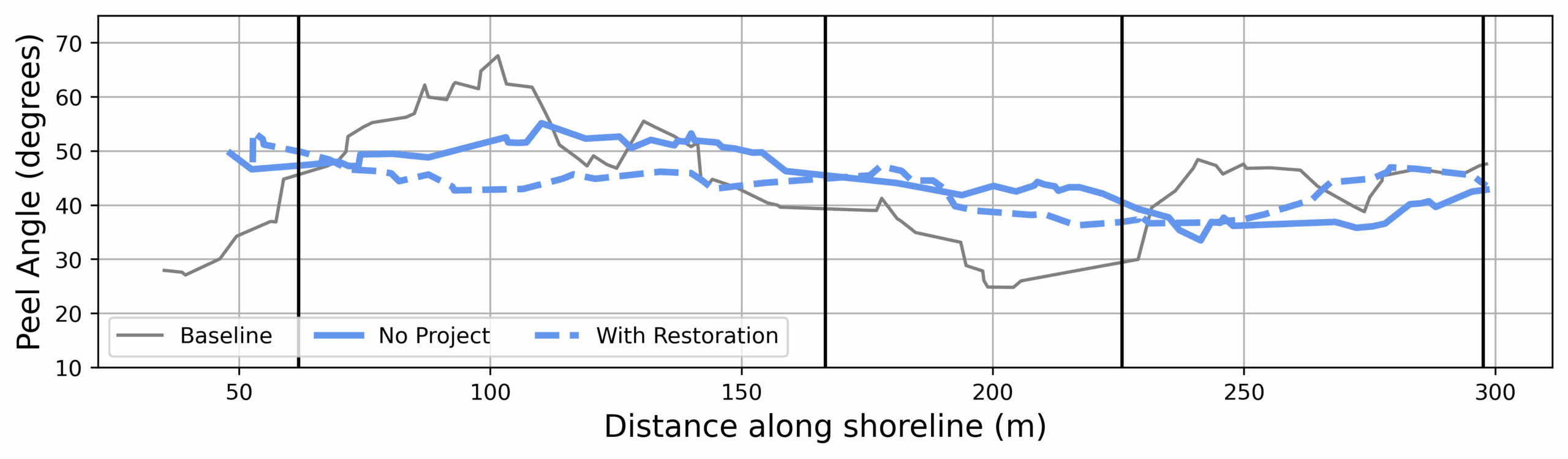
Wet Conditions After 1 Year
Project causes peel angle to be slightly lower, resulting in steeper, faster waves.
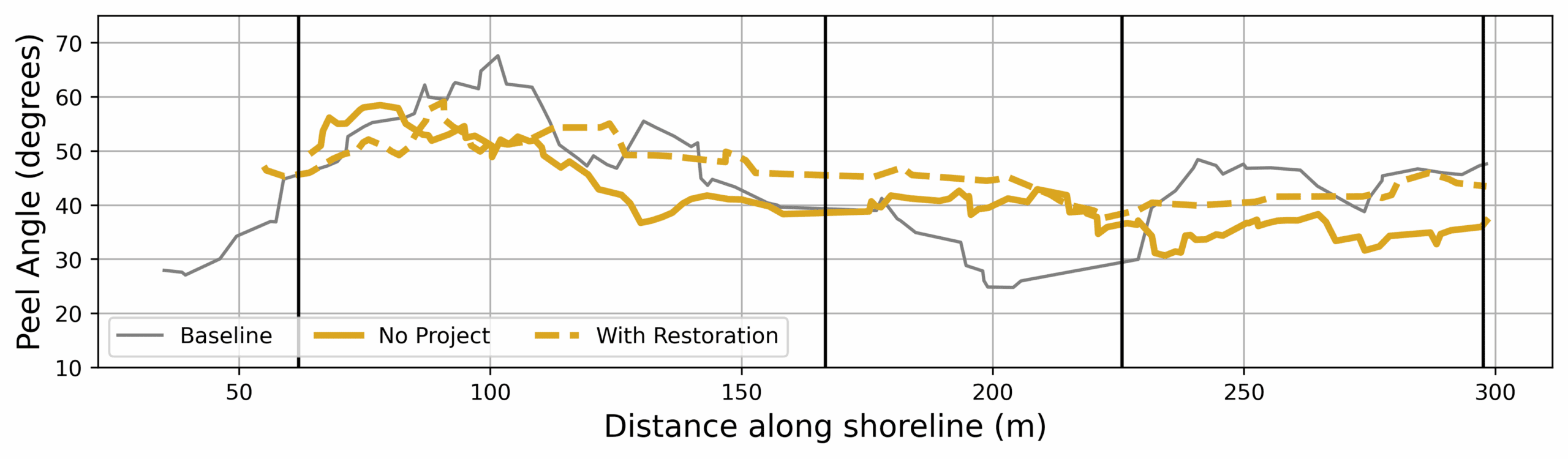
Drought Conditions After 1 Year
Project causes peel angle to be slightly higher, resulting in a slower wave, more suited to turns.
The Result
Zero long-term surf quality impacts demonstrated scientifically, transforming 65% opposition into project support and establishing a new standard for coastal recreation assessment.
The quantitative results provided definitive answers to community concerns:
Short-term effects (1 year): Minor variations in wave characteristics during wet and drought conditions, all within natural variability ranges. Project impacts remained negligible compared to normal seasonal fluctuations.
Long-term assessment (5+ years): No measurable project impacts on surf quality under any modeled conditions. Natural coastal processes restore baseline wave characteristics, confirming surfers’ waves would remain unchanged.
Future perspective: Sea level rise of 6.6 feet by 2100 represents the primary long-term threat to surf quality—far exceeding any potential restoration project effects.
The community response transformation was dramatic. Pre-assessment opposition of 65% shifted to supportive comments during environmental review proceedings. Local surfers became project advocates, recognizing that lagoon restoration would proceed without harming their surf break.
Beyond immediate project approval, this work established the first standardized methodology for surf quality impact assessment, creating a framework that coastal managers worldwide can now apply to similar projects. The approach demonstrates how technical innovation combined with genuine community engagement can resolve seemingly intractable stakeholder conflicts.
The number of surfable days will go down

The overall surf quality will go down


Project Highlights
- Innovation Achievement: First quantitative surf quality impact assessment methodology developed for coastal management applications
- Community Transformation: 65% surfer opposition converted to project support through evidence-based analysis