
Delineating the Downgradient End of a Groundwater Plume Originating from a Neighboring Property
Key Personnel
Nicole Ott Principal, Hydrology, Geosciences, and Chemistry
Mauri Fabio Scientist
The Challenge
Historical spills of oils and fuels at an industrial site in Washington previously used for petroleum storage (“Tax Parcel #0001” in Figure 1, the source property) have contaminated the soil and groundwater, creating a plume affecting a downgradient site (Tax Parcel #0002, the subject property). A site is defined by the extent of contamination, regardless of property lines (the entirety of red and blue in Figure 1).
The Washington State Department of Ecology (Ecology) provides guidance for scenarios in which a single source affects multiple properties. After some degree of site investigation and remediation has occurred, Ecology can issue opinions identifying whether further action is required. Such opinions can apply to the site as a whole, or the individual properties constituting the site, depending upon the extent and effectiveness of the cleanup (Ecology 2015).
On behalf of our client, and in accordance with the Washington State Model Toxics Control Act (MTCA), Integral delineated the extent to which contamination had migrated from the source property onto the subject property. Contamination was found in soil over the property boundary between the two properties (A2 in Figure 1), suggesting spills along the margins of the source property. Further, groundwater migration has spread petroleum hydrocarbons beyond the property boundary and onto the downgradient subject property (B2 in Figure 1), leading to the “site” encompassing both the source property and the subject property.
Under the MTCA Voluntary Cleanup Program, the source property representative is the “owner” of the site, which includes both properties. The owner is seeking a no-further-action opinion from Ecology, in the absence of any meaningful remediation of its sources (A1 and B1, in Figure 1), and despite the fact that its releases have affected the subject property (A2 and B2). A condition of the no-further-action opinion involves execution of an environmental covenant on each affected property. As presented, the site owner is seeking the property owners to encumber the properties with restrictive covenants in lieu of any cleanup of the sources.
In addition, the subject property is currently used for light industrial purposes (construction equipment storage and maintenance), which requires handling of fuels and oils, the same category of contaminants historically released from the source property. Thus, a poorly designed investigation could conflate subject property activities with groundwater transport of source property contamination. Data collection and evaluation of upgradient impacts need to inform next steps to support a no-further action determination.
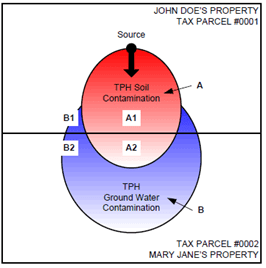
Figure 1. Conceptual illustration of one source of contamination affecting two adjacent properties: the source property (#0001) and the subject property (#0002) (Source: Plate 1 in Appendix B of Ecology 2015).
Our Role
No indications of mishandling or spills of fuels and oils were observed at the subject property. Our client opted to collect its own data from its property to delineate upgradient source property contamination that has migrated onto the subject property. Integral developed a tiered sampling approach, starting with soil and groundwater sampling from temporary wells at the upgradient edge of the subject property. Data generated from initial sampling was used to plan a network of temporary wells, which led to selection of permanent monitoring well installation and ongoing quarterly groundwater sampling. The sampling program also included collecting additional soil cores along the upgradient property boundary to delineate the lateral extent of historical spills on the source property that have affected the subject property. We also managed the data and prepared reports to share with the source property representatives (the site “owner”).
What We Delivered
Within the source property, concentrations of petroleum hydrocarbons are at least 10 times the cleanup levels, whereas they are 1- to 2-fold on the subject property. We established a data set and mapped concentration gradients that make it clear that the subject property (#0002) was affected by downgradient transport of groundwater from the source property (#0001) and from spills near the property boundary. These data also support the need for focused remediation (hot spot excavation, pump and treat) of the source area, allowing for subsequent natural attenuation of the lower-level impacts on the source property.
Integral has also advised the team on strategic responses to the no-further-action request. When source contamination is not addressed through remediation, engineering constraints to prevent further migration onto our subject property can be considered. Ecology guidance envisions the use of a barrier between the properties allowing for a no-further-action determination for Area B of Property #0002 (Figure 2). However, such a barrier in the absence of source property hydraulic controls or remediation is technically infeasible and unlikely to be effective for long-term remediation. There are no scenarios in Ecology’s guidance by which a no-further-action determination is granted for the site as a whole or for the source property in the absence of remediation of the source
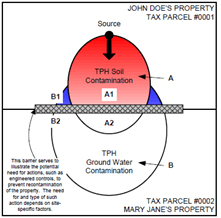
Figure 2. Conceptual illustration of engineering actions in the absence of remediation of the contaminated source property allowing for a no-further-action determination on the subject property (#0002) (Source: Plate 1F in Appendix B of Ecology 2015).
The Result
Integral’s data collection and evaluation have allowed us to characterize the extent of an upgradient sourced groundwater plume and to advise the team on future actions. Our focused sampling approach will facilitate expedited progress toward next steps. Our strategic review of guidance and data and our sound advice builds the technical foundation for our client’s decision-making.
Reference
Ecology. 2015. Guidelines for Property Cleanups under the Voluntary Cleanup Program. Washington State Department of Ecology, Toxics Cleanup Program. Publication No. 08-09-044. Revised July 2015.