Achieving Fair Cost Allocation in Complex Superfund Litigation
Project Summary
Strategic scientific analysis and expert testimony secured an equitable settlement in a decades-long CERCLA dispute.
When a responsible party at a Superfund site faced demands to entirely fund a cleanup based on inflated costs and technically flawed cleanup goals, they turned to Integral Consulting for a strategic defense. Over nearly 3 years (2022–2025), Integral’s multidisciplinary team conducted comprehensive site characterization, developed a site-specific ecological risk assessment, designed and implemented site-specific toxicity and bioaccumulation bioassays, and designed a cost-effective remedy that led to a favorable settlement—enabling the site to move forward with an environmentally protective cleanup while achieving equitable cost allocation among responsible parties.
Location: Ohio, USA
Key Personnel
Miranda Henning, BCES Managing Principal, Business Director - Health and Ecology
Jen Lyndall, CERP, CSE Principal
David Livermore, R.G., L.H.G., CWRE Senior Principal
Challenge
When generic cleanup standards threaten to impose unnecessary costs and delay environmental protection, scientifically defensible alternatives become essential.
The client, one of several potentially responsible parties at a Superfund site, was asked to entirely fund a cleanup despite shared responsibility—creating disproportionate financial liability and business uncertainty. The selected remedy and cleanup goals included technical errors and were developed using methods inconsistent with U.S. Environmental Protection Agency (EPA) guidance, in that they relied on generic default values rather than site-specific risk assessment and did not adequately consider all potential removal alternatives. Taken together, these errors unnecessarily inflated cleanup costs.
Current site owners had already delayed investigation and cleanup for decades, and continued disputes threatened further delays while exaggerating the client’s financial exposure. With the cleanup plan already issued for public comment, the state regulatory agency was eager to begin work, creating urgency for resolution despite fundamental technical disagreements. Adding to the complexity, the current site owners were reluctant to deviate from outdated methodologies despite their inconsistency with current EPA guidance, which added challenge to the technical negotiations.
Our Role
Integral brought rigorous site-specific science and strategic litigation expertise to develop a technically defensible, cost-effective remedy consistent with EPA guidance.
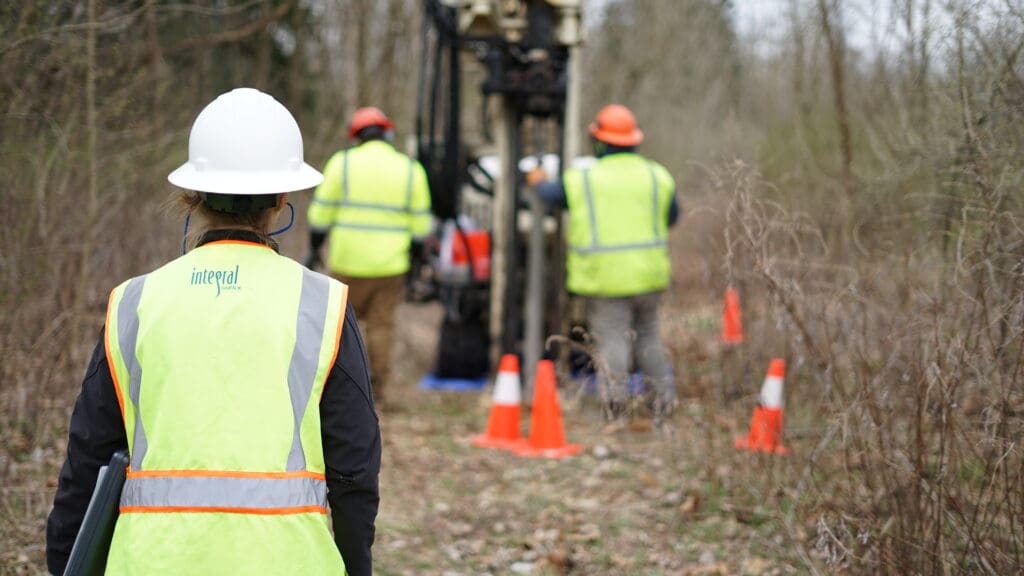
Our multidisciplinary team combined investigation, remediation, risk assessment, strategic negotiation, and testifying expertise to address the technical and legal complexities of this CERCLA cost recovery case. We designed and executed a robust field sampling program that provided reliable site-specific data to characterize conditions, assess risks to human health and the environment, and develop remedial options.
Our approach differed from that of the current site owners by:
- Considering all relevant remedial technologies for the site
- Evaluating multiple lines of evidence in ecological risk assessment
- Conducting innovative site-specific plant and earthworm toxicity testing and bioaccumulation studies
- Leveraging advanced tools including spatially-explicit analysis, statistical methods for data evaluation, geoprobes for efficient sampling, QNOPY to digitize soil core logging, and Scribe to automate chain-of-custody documentation
- Incorporating statistical evaluation to refine removal depths necessary for sitewide risk reduction
What We Delivered
Site-specific scientific analysis supported a technically rigorous remedy that was both cost-effective and environmentally protective.
We delivered comprehensive mediation and settlement presentations, two detailed expert reports, and expert testimony that demonstrated how site-specific data supported more appropriate cleanup goals. Our field sampling program, implemented to support the allocation at the site, efficiently collected the critical data needed to conduct robust ecological risk assessments using current EPA methodologies, including specialized toxicity testing not often conducted at Superfund sites.
Our data management and analysis capabilities enabled clear visualization of complex technical information for legal audiences, bridging scientific rigor with effective communication. Our remedial design and cost estimates provided realistic alternatives that addressed actual site-specific risks rather than generic assumptions, fundamentally changing the economic calculus of the dispute.
The Result
A favorable settlement enabled equitable cost allocation and cleared the path for environmental protection.
The case settled prior to trial, with both parties agreeing to pay allocated past costs and anticipated remedy costs from Integral’s site-specific analysis—a significant achievement given the decades-long dispute. The settlement remedy was not only less expensive but also less environmentally damaging and more sustainable than the original proposal, demonstrating that rigorous science produces better outcomes for all stakeholders.
By resolving the allocation dispute, the settlement enabled the remediation to proceed, which will address site-specific risks to human health and the environment that had persisted for decades.
The Court entered the consent decree in the…litigation, so that case is officially settled and we will not be going to trial. Thank you all so much for all of your hard work on this matter over the last couple of years. We truly could not have reached such a successful resolution of this matter without your expertise.
Client Testimonial
Project Highlights
- Multidisciplinary Approach: Integrated investigation, risk assessment, remedial design, cost estimation, and litigation support from coordinated expert teams
- Innovative Risk Assessment: Site-specific plant and earthworm toxicity testing and bioaccumulation studies provided multiple lines of evidence for ecological risk evaluation
- Strategic Resolution: Achieved favorable settlement that allocated costs equitably while enabling environmental protection to proceed