
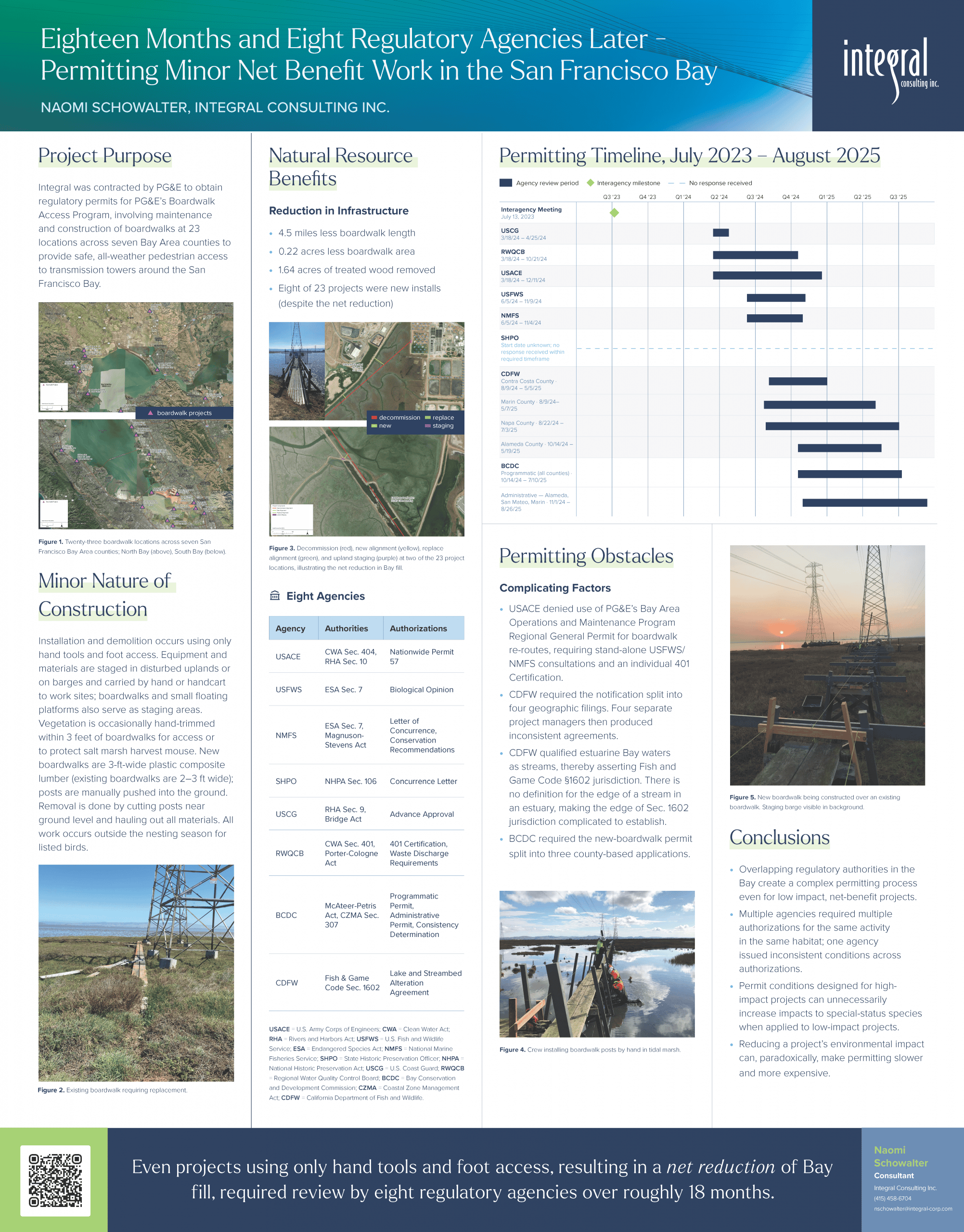
Even projects using only hand tools and foot access, resulting in a net reduction of Bay fill, required review by eight regulatory agencies over roughly 18 months.
Project Purpose
Integral was contracted by PG&E to obtain regulatory permits for PG&E’s Boardwalk Access Program. The program involves maintenance and construction of boardwalks at 23 locations across seven Bay Area counties, providing safe, all-weather pedestrian access to transmission towers around the San Francisco Bay.
Minor Nature of Construction
Installation and demolition occur using only hand tools and foot access. Equipment and materials are staged in disturbed uplands or on barges and carried by hand or handcart to work sites; boardwalks and small floating platforms also serve as staging areas. Vegetation is occasionally hand-trimmed within 3 feet of boardwalks for access or to protect the salt marsh harvest mouse.
New boardwalks are 3-ft-wide plastic composite lumber (existing boardwalks are 2–3 ft wide), and posts are manually pushed into the ground. Removal is done by cutting posts near ground level and hauling out all materials. All work occurs outside the nesting season for listed birds.
Natural Resource Benefits
Reduction in Infrastructure
- 4.5 miles less boardwalk length
- 0.22 acres less boardwalk area
- 1.64 acres of treated wood removed
- Eight of 23 projects were new installs (despite the net reduction)
Eight Agencies
| Agency | Authorities | Authorizations |
|---|---|---|
| USACE | CWA Sec. 404, RHA Sec. 10 | Nationwide Permit 57 |
| USFWS | ESA Sec. 7 | Biological Opinion |
| NMFS | ESA Sec. 7, Magnuson-Stevens Act | Letter of Concurrence, Conservation Recommendations |
| SHPO | NHPA Sec. 106 | Concurrence Letter |
| USCG | RHA Sec. 9, Bridge Act | Advance Approval |
| RWQCB | CWA Sec. 401, Porter-Cologne Act | 401 Certification, Waste Discharge Requirements |
| BCDC | McAteer-Petris Act, CZMA Sec. 307 | Programmatic Permit, Administrative Permit, Consistency Determination |
| CDFW | Fish & Game Code Sec. 1602 | Lake and Streambed Alteration Agreement |
Permitting Timeline, July 2023 – August 2025
| Agency / Milestone | Review Period |
|---|---|
| Interagency Meeting | July 13, 2023 |
| USCG | 3/18/24 – 4/25/24 |
| RWQCB | 3/18/24 – 10/21/24 |
| USACE | 3/18/24 – 12/11/24 |
| USFWS | 6/5/24 – 11/9/24 |
| NMFS | 6/5/24 – 11/4/24 |
| SHPO | Start date unknown; no response received within required timeframe |
| CDFW – Contra Costa County | 8/9/24 – 5/5/25 |
| CDFW – Marin County | 8/9/24 – 5/7/25 |
| CDFW – Napa County | 8/22/24 – 7/3/25 |
| CDFW – Alameda County | 10/14/24 – 5/19/25 |
| BCDC – Programmatic (all counties) | 10/14/24 – 7/10/25 |
| BCDC – Administrative (Alameda, San Mateo, Marin) | 11/1/24 – 8/26/25 |
Permitting Obstacles
Complicating Factors
- USACE denied use of PG&E’s Bay Area Operations and Maintenance Program Regional General Permit for boardwalk re-routes, requiring stand-alone USFWS/NMFS consultations and an individual 401 Certification.
- CDFW required the notification to be split into four geographic filings. Four separate project managers then produced inconsistent agreements.
- CDFW qualified estuarine Bay waters as streams, thereby asserting Fish and Game Code §1602 jurisdiction. There is no definition for the edge of a stream in an estuary, making the edge of Sec. 1602 jurisdiction complicated to establish.
- BCDC required the new-boardwalk permit to be split into three county-based applications.
Conclusions
- Overlapping regulatory authorities in the Bay create a complex permitting process, even for low-impact, net-benefit projects.
- Multiple agencies required multiple authorizations for the same activity in the same habitat; one agency issued inconsistent conditions across authorizations.
- Permit conditions designed for high-impact projects can unnecessarily increase impacts to special-status species when applied to low-impact projects.
- Reducing a project’s environmental impact can, paradoxically, make permitting slower and more expensive.
Contact
Naomi Schowalter
Consultant, Integral Consulting Inc.
(415) 458-6704 | nschowalter@integral-corp.com