
Vapor Intrusion and Indoor Air Quality
Indoor Air Quality You Can Verify, Document, and Protect
As the owner of a building or property, you prioritize the health and safety of the people who breathe the air within the building under current or future use scenarios. We understand the risks, regulations, and remediation strategies to engineer a sustainable solution that meets the needs of the property owner, the occupants, the community, and the environment. Integral’s diverse group of engineers and scientists have the range of skills and experience to assess a site, design appropriate remediation strategies that meet all stakeholder needs, and provide litigation support for the development of a healthy building and healthy community.
Vapor Intrusion and Indoor Air Quality Leaders
Susan B. Welt, MPH, P.E. Principal, Engineering
Stephen Sherman, P.G. Consultant
Alexandra Meyers, MPH, BCES Consultant
M. Andrew Maier, Ph.D., CIH, DABT, Fellow AIHA, Fellow ATS Principal, Toxicology, Health, and Ecological Sciences
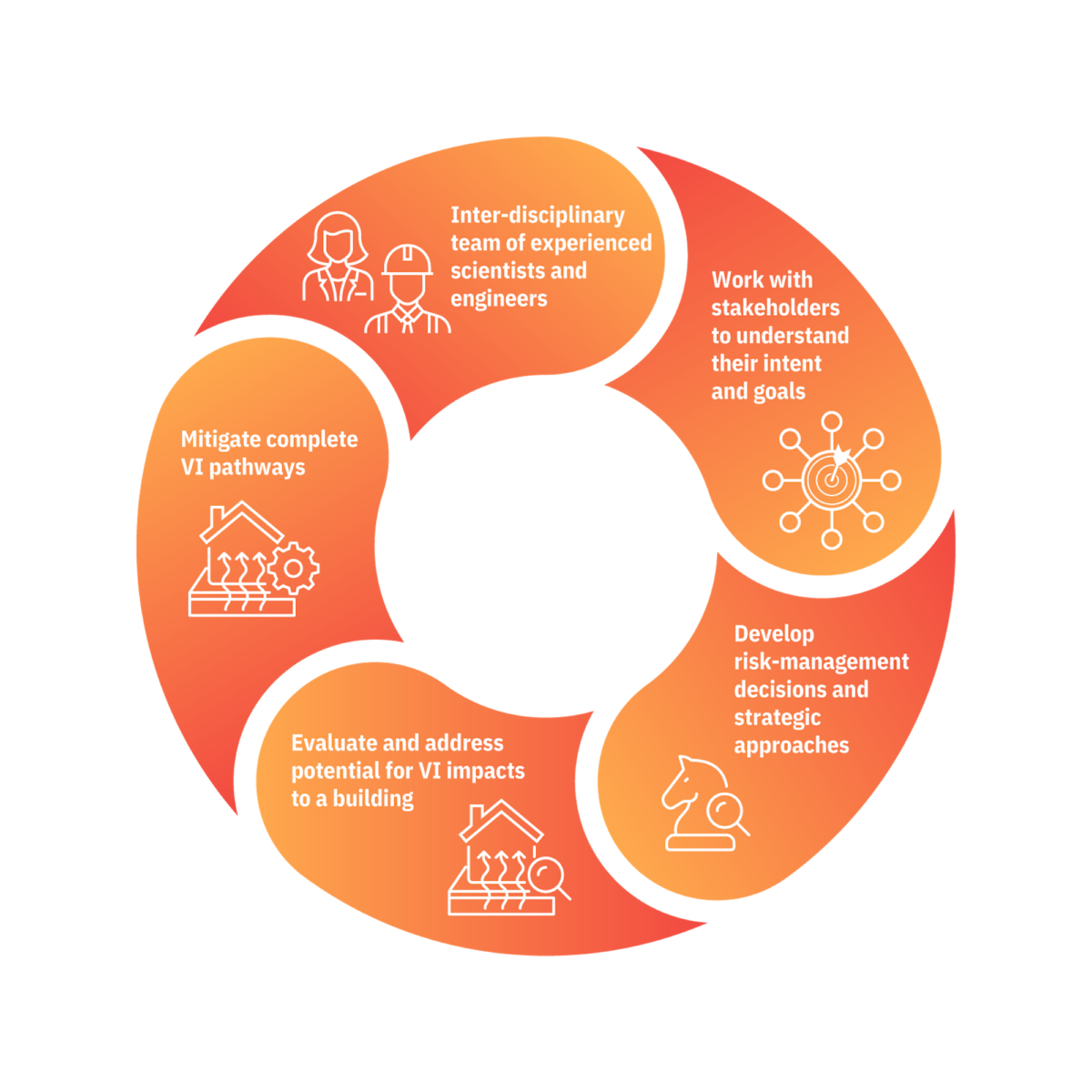
Vapor Intrusion Life Cycle
Featured Insights
Addressing the Vapor Intrusion Pathway at Middlefield‐Ellis‐Whisman Superfund Study Area
Vapor Intrusion Evaluation at a Daycare Facility in a Disadvantaged Community
Efficient Soil Vapor Investigation Planning for Former Chemical Distribution Facility
Understanding PFAS Volatility and Potential Impact on Indoor Air Quality
Addressing Vapor Intrusion: Webinar
Vapor Intrusion Evaluation at a Daycare Facility in a Disadvantaged Community
Site Characterization and Exposure Assessment
Knowing whether indoor air is affected, and by how much, requires more than a single data point. Integral’s scientists and engineers collect and interpret data across multiple environmental media to build a defensible picture of current and potential exposure, so you know where you stand and what, if anything, needs to be done.
Key Capabilities:
- Evaluating multiple lines of evidence including sampling results (indoor air, subslab soil vapor, groundwater, and outdoor air) and building surveys
- Developing a site-specific conceptual site model (CSM) that translates complex data into a clear narrative
- Using risk-based interpretation of results that connect findings to actual health implications for building occupants
- Designing fieldwork and data collection to answer your specific regulatory and business questions efficiently.

Risk Management and Mitigation
Every site is different, and so is every decision about how to respond to potential indoor air quality concerns. Integral’s comprehensive team includes risk assessors, scientists, and engineers to evaluate your options and recommend approaches that comply with regulations and balance occupant protection with practical, cost-effective implementation.
Key Capabilities:
- Risk-based strategies that distinguish between sites requiring active mitigation and those that don’t
- Engineering design and implementation of vapor intrusion control measures, including subslab depressurization and other interim remedial measures (IRMs)
- Development of site management plans and operation, maintenance, and monitoring (OMM) plans suitable for inclusion in regulatory orders
- Assessment of long- and short-term liabilities to inform your decision-making
- Development and implementation of work plans to assess and remediate the source of contaminants impacting indoor air quality.
- Support for institutional and engineering controls that reduce long-term liability exposure.
Data Management and Ongoing Monitoring
Indoor air quality can change as site conditions evolve. Integral maintains the baseline and monitoring data you need to detect meaningful changes, support regulatory reporting, and make informed decisions over time without having to reconstruct the site history each time a question comes up.
Key Capabilities:
- Integrated and interactive databases linking environmental data (soil vapor, indoor air, groundwater) with building-specific information including occupancy, HVAC systems, and structural modifications to facilitate active communication and decision-making
- Periodic reporting designed to be clear and actionable for both regulators and property decision-makers
- OMM support that keeps your program running without unnecessary disruption.
Stakeholder Communication and Community Engagement
Indoor air concerns affect real people, and how you communicate those concerns matters as much as what you do. Integral’s team is experienced at translating technical findings into plain language for building occupants, community members, and regulators, so everyone understands what the data shows, what steps are being taken, and why these steps will happen.
Key Capabilities:
- Proactive communications about sampling plans, results, and next steps, developed before questions become concerns
- Fact sheets and accessible summaries written for nontechnical audiences
- Support for community meetings and one-on-one engagement with affected residents or tenants
- Coordination across Integral’s engineering, risk, and regulatory staff so your communications reflect a single, consistent technical position.

FAQs
There are many factors which could trigger the need for an indoor air assessment including, but not limited to, regulatory requirements, occupant complaints, and volatile compounds detected in groundwater and soil under and proximate to the building.
Integral’s team of scientists, industrial hygienists, and engineers are skilled at evaluating indoor air which may be impacted by
- Indoor sources such as combustion appliances (e.g., stoves, water heaters, and fireplaces that emit harmful gases like carbon monoxide, nitrogen dioxide, and particulate matter); household items and activities (e.g., paints, cleaning supplies, adhesives, air fresheners, some pressed-wood furniture, 3-D printing, smoking that emits volatile compounds and particulates); and biological contaminants (e.g., mold, mildew, bacteria)
- Subsurface sources such as volatile compounds (e.g., some petroleum hydrocarbons, mercury, chlorinated solvents, PFAS) and radon which can enter buildings through preferential pathways (e.g., cracks in the foundation, pipe penetrations).
Evaluating indoor air quality requires effective communication with the building owner and occupants and implementation of Integral’s multiple-lines-of-evidence approach to assess potential sources of the contaminant detected in indoor air. These lines of evidence include:
- Defining the problem, which may include, but not be limited to, evaluating known subsurface environmental data and site history, interviewing building occupants, and logging complaints
- Developing the plan and communicating the proposed work to evaluate indoor air quality, which will be done in a manner which limits disruption to building occupants as much as possible
- Conducting a building walkthrough to identify indoor air pollutant sources, preferential pathways for subsurface vapor intrusion, and ventilation issues
- Sampling (indoor air, outdoor air, subslab soil vapor) and analysis
- Evaluating data, which may include comparison to regulatory screening levels and assessing risk to current and future building occupants
- Communicating the results and path forward.
Integral’s engineers, regulatory compliance personnel, and risk assessors are prepared to implement the appropriate response to address potential risk to building occupants throughout the entire evaluation process. These actions may include recommending increasing ventilation or HVAC modification, cleaning HVAC ducts; operating air filters; addressing impacted building materials (e.g., mold remediation); sealing preferential pathways; installing and operating vapor intrusion mitigation measures; remediating soil or groundwater; and vacating the building. Integral’s team is prepared to work with the building owner to develop the appropriate response(s) effectively and efficiently to address the potential risk posed by the indoor air.
Integral’s team of engineers, risk assessors, and regulatory staff work with the building owner, its representative and, as needed, regulatory agencies, to develop proactive communications about sampling plans, results, and next steps before questions become concerns; and provide support for community meetings and one-on-one engagement with affected building occupants. Our integrated proactive approach builds trust and credibility among the stakeholders, facilitating effective and efficient assessments and response actions in what may be stressful environments.