
Conservation easement deductions are measured against what the land could be worth if developed, which can produce large deductions when appraisals run high. This rule has become a flashpoint in valuation disputes, particularly over highest and best use (HBU) (see Stanley Works & Subs. v. Commissioner, 87 T.C. 389, 400 (1986); Treas. Reg. § 1.170A-14(h)(3)(i) and (ii)). The debate reflects a disconnect between how the law defines conservation value for tax purposes and how society experiences the benefits of nature. Tax attorneys, appraisers, and land trusts face two increasingly pressing questions: what is conserved land truly worth in the marketplace, and what is the relevant marketplace by Internal Revenue Service (IRS) standards?
Here, we examine the gap between economic outcomes that maximize public welfare (and the tax benefit donors would receive if that standard were applied) and the way the IRS actually values easements. In our view, the gap arises from a difference in scale: the IRS focuses on the HBU of an individual parcel, while public value recognizes spatial spillover effects at a broader scale.
The challenge for donors arises from the fact that the IRS focuses on the market value of the parcel and does not count public values toward HBU. When a parcel has a large public value well above the market-based IRS HBU, a donor may seek an alternative to the easement tax benefit in order to leverage that unrecognized public value.
We argue that HBU analysis should look more closely at the mix of full and partial development, because partial development can create parcel-level price premiums from proximity to preserved natural areas. We also explore alternatives to the federal deduction that could help donors avoid long, costly litigation with the IRS.
Conservation Easements Under IRS Standards
What is necessary for conservation easements to qualify as deductible charitable contributions? Under Internal Revenue Code (IRC) § 170(h), the easement must be granted in perpetuity to a qualified organization and must be made exclusively for one or more recognized conservation purposes. Section 170(h)(4)(A) lists four:
- The preservation of land for outdoor recreation by, or education of, the general public
- The protection of a relatively natural habitat of fish, wildlife, or plants, or similar ecosystem
- The preservation of open space for scenic enjoyment of the general public or pursuant to a clearly delineated governmental conservation policy, where it will yield a significant public benefit
- The preservation of historically important land areas or certified historic structures.
The IRS and many state courts focus on the actual conservation values protected by the easement rather than the type of property. A property does not lose eligibility to become a conservation easement because it contains developed or managed areas, provided the easement will protect significant conservation resources and impose enforceable restrictions that further a qualifying conservation purpose.
Conservation Purpose in Practice: The Champions Retreat Case
Champions Retreat Golf Founders, LLC v. Commissioner, 959 F.3d 1033 (11th Cir. 2020), illustrates the principles above. The case involved a conservation easement covering approximately 348 acres that included a private golf course as well as substantial undeveloped forests, wetlands, and riparian habitat along the Savannah and Little Rivers. The property supported numerous wildlife and plant species, including several bird species, the southern fox squirrel, and denseflower knotweed, a rare plant. A stylized version of this setting is shown in Figure 1.
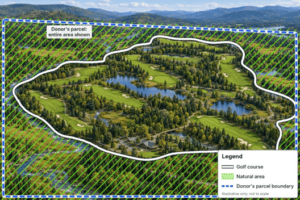
Figure 1. Pre-easement Scenario of a Golf Course Surrounded by Natural Area
The IRS initially disallowed the deduction, and the Tax Court agreed (T.C. Memo. 2018-146), largely because the easement encompassed an operating private golf course. The Eleventh Circuit vacated and remanded, holding that “the Code does not disqualify an easement just because it includes a golf course.” The court emphasized that the proper inquiry was whether the easement protected a “relatively natural habitat of fish, wildlife, or plants” or preserved qualifying open space. Because the property contained significant natural habitat and rare species, the court held that the easement satisfied both the habitat and scenic open-space purposes (IRC § 170(h)(4)(A)(ii) and (iii)(I)) despite the golf course.
The key point is that the property held public value despite its status as a golf course. Its wildlife habitat and its scenic view from the rivers satisfied purposes 2 and 3 above. These same features also influenced the HBU determination, discussed below. The lesson for donors is that evaluation of a property for a potential conservation easement involves demonstrating its conservation value, which is not necessarily undermined by a degree of development.
Highest and Best Use under IRS Standards
Under 26 U.S.C. § 170(h) and Treas. Reg. § 1.170A-14(h)(3), landowners (potential land donors) seeking a charitable deduction must demonstrate the change in value through a before-and-after appraisal that values the property in the “before scenario” at its HBU: the reasonably probable, legally permissible use that yields the highest value. The IRS takes a market-centric view of HBU: only what a hypothetical buyer would pay counts, excluding reasons an owner might rationally choose not to fully develop, such as personal or public values that undeveloped land provides that markets do not price. Those choices are no less “economic” than market values, yet federal appraisal standards draw the same line, barring appraisers from considering “public interest value or related concepts” because they are not “market considerations” (see Uniform Appraisal Standards for Federal Land Acquisitions).
The IRS interpretation has led to disallowed deductions and extensive litigation. In Excelsior Aggregates LLC et al. v. Commissioner, the IRS argues that beyond falling outside “market considerations,” petitioners’ environmental valuations cannot explain why a willing buyer would pay the resulting fair market value (FMV). Thus, the IRS may view the HBU as akin to Figure 2.

Figure 2. Golf Course Surrounded by Fully Developed Neighborhood
While the circumstance of Figure 2 is often viewed as describing HBU from the IRS perspective, consider an alternative partial-development HBU scenario shown in Figure 3.
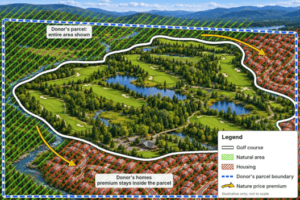
Figure 3. Golf Course Surrounded by a Partial Development
If the natural area confers within-parcel benefits to residents in a developed zone, property values may be increased sufficiently to provide a total value of the parcel larger than the full development HBU scenario in Figure 2. Because the effects of the natural area on housing values are internal to the property, this would be reflected in purely market-based valuations if they are done accurately. This approach should pass muster with the IRS because market evidence would reveal the HBU for the property.
In this case, the donor needs an analysis demonstrating the spillover from nature to the value of housing in actual housing markets via appraisal methods or hedonic property value studies showing the increase in value with proximity to natural areas.
On remand in Champions Retreat Golf Founders, LLC v. Commissioner, T.C. Memo. 2022-106, the Tax Court found that the property’s pre-easement HBU was “a residential subdivision with an 18-hole golf course.” The court agreed that the views of nature and river frontage provide increased property value, implying that there is a mechanism by which a market transaction has ties to valuation of environmental goods and services. The taxpayer also successfully argued that were this area to be fully developed, the property values in the existing residential area would decrease due to lost views and recreational opportunities. Thus, there is a basis for accepting environmental values as a consideration in HBU determinations. This opens the door to analyses supporting the situation in Figure 3: is the value-maximizing decision to build 50 homes using up all the land, or to build 20 houses, all of which have significantly increased value due to their proximity to the remaining preserved natural area? It may be judged that this is like any other value-maximizing decision to be made by a private landowner.
Now consider the exact same scenario as Figure 3, but with one change. The donor’s parcel boundary is now at the edge of the developed neighborhood, and the housing that benefits from the easement sits on neighboring parcels owned by others. The benefits of nature now accrue to a set of existing households that are external to the property.
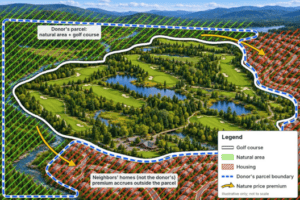
Figure 4. Golf Course Surrounded by Partial Development Under a Scenario of a Donated Easement
Figure 4 is economically the same as Figure 3 in every way, yet the two would be treated entirely differently by the IRS. The increased market value in Figure 3 resides within the potential donor’s parcel while in Figure 4 it resides with adjacent households. While the total social value of nature is the same in the two figures, in one the donor can realize the value as a tax deduction and in the other the donor cannot. HBU according to the IRS in the scenario of Figure 4 would presumably look like Figure 2 because the increase in value across the street is a public value unrecognized by the IRS.
The conservation scenarios in Figure 3 and Figure 4 both maximize social value, but conservation is realized in Figure 3 as the outcome of private decision-making, whereas this does not occur in Figure 4 due to a market failure. If the homeowners across the street in Figure 4 could get together and bargain with the owner of the easement parcel the efficient outcome could be achieved and the value of nature realized by the parcel owner. This is the lesson of Coasian bargaining theory from standard economics: when bargaining is costless, the parties affected by an externality can negotiate their way to the efficient outcome, no matter who holds the property rights. However, this theoretical solution breaks down because it assumes there are no bargaining costs. The households across the street have a collective action problem: if they all get together and act as one unit, the payment to the donor to protect the natural area could be achieved, but there are coordination cost barriers to individual households and therefore the Coasian outcome may not occur. Private decision-making will fail to maximize value due to uncorrected externalities.
One way around the conundrum in Figure 4 is for a governmental entity to act on behalf of the adjacent community, purchasing and preserving the natural area. The agreed-upon price would fall between the maximum the government would pay (presumably the social value of the natural area as measured in the adjacent community) and the profit the owner would earn from development. A potential donor might bring this reasoning to the IRS and cite evidence to support the notion.
There is ample evidence that governmental agencies will purchase lands for conservation purposes above the appraised market value. Programs like Florida Forever, which acquire land under Fla. Stat. § 259.041, can pay above appraised value when ecological or recreational benefits justify the premium. For example, the program purchased Babcock Ranch in 2006, preserving, together with Lee County, approximately 74,000 acres in the counties of Charlotte and Lee in southwest Florida. Although the property’s estimated value was $52.5 million when it was approved for acquisition in 2002, the State and Lee County paid $350 million, citing the need to “protect and preserve for future generations the scientific, scenic, historic, and natural values of the ranch, including rivers and ecosystems; to protect and preserve the archaeological, geological, and cultural resources of the ranch; to provide for species recovery; and to provide opportunities for public recreation” (see FL Senate Staff Bill CS/SB 1226 Senate Staff Analysis and Economic Impact Statement). And in September 2025, the state approved an $83.3 million purchase of about four acres of harbor-front land in Destin—well above both its appraisals (roughly $67–68 million) and the seller’s $7.9 million purchase in 2016–2017—citing public access and coastal preservation as key drivers.
These transactions suggest that environmental amenities generate real monetary value in real estate markets when a public entity acts on behalf of the public. Economic nonmarket valuation methods can show that such purchases are “worth it” to the public if estimated social willingness to pay for the amenities exceeds the purchase price. However, the IRS looks askance at such an approach to estimating HBUs, arguing that it fails, or overstates value, for two reasons. First, fair market value under Treas. Reg. § 1.170A-1(c)(2) is the price at which a property would change hands between a “willing buyer and a willing seller, neither being under any compulsion to buy or sell and both having reasonable knowledge of relevant facts.” In many cases, the IRS contends that governments would not pay the claimed amounts for the parcels. Second, the IRS argues that a use supported by nonmarket value (the basis for the government’s willingness to pay) fails one of the four HBU tests: physically possible, legally permissible, financially feasible, and maximally productive.
The IRS has successfully resisted government purchases as market comparables for HBU purposes (IRS, 2000), arguing that the state is not a profit-motivated willing buyer and that its governmental authority creates a monopsony that distorts prices away from arm’s-length transactions. A landowner considering a donation in the circumstances of Figure 4 can be reasonably sure that the easement or tax relief approach will fail.
Conservation Easements Outside of IRS Standards
Public acquisition practices below the federal level may offer landowners a way to capture societal value that fair market value misses. Owners might realize the external benefits by going directly to nonfederal conservation agencies. For example, states and municipalities routinely pass bonds that are used to purchase open space for preservation and conservation. Bond approvals signal that the public places value on land conservation.
Other states offer similar alternatives to the federal deduction. As of January 2025, 29 states had state-level Purchase of Agricultural Conservation Easements programs, also known as Purchase of Development Rights. Rather than a deduction defended under audit, these programs pay landowners up front for their development rights (Farmland Information Center, 2025). Some states (e.g., Virginia, Colorado, Georgia) also reward easement donations, adding transferable state tax credits that donors can sell for liquidity (Lincoln Institute of Land Policy, 2026). State and municipal purchases are often less lucrative than a federal deduction (Florida’s above-FMV purchases notwithstanding), but they carry far less cost and risk than defending HBU before the IRS.
Conclusion
The disconnect between legal and economic measures of value has created uncertainty for landowners, attorneys, and conservation organizations. The IRS has successfully dismissed public interest values for lack of a true buyer, but HBU analysis should still account for the benefit of preserving some part of a parcel while developing the rest. For tax attorneys handling conservation easements, this calls for a strategic, interdisciplinary approach, one that blends legal acumen with environmental economics, ecology, and policy insight.
The main appeal of the federal deduction is tax savings that can far exceed most state and municipal funding. The HBU approach allows landowners to capitalize on what the land could be worth if developed, which, with the right appraisal, can be substantial. Unlike state programs, the federal deduction is not limited by an appropriation that may not cover the purchase. On the other hand, IRS enforcement and Tax Court litigation may cost more in legal fees and frustration than the donor gains over a simpler state or local route. For a more commercial property, like the golf course and residential complex in Champions Retreat, the federal deduction may be more worthwhile than purely ecological land or farmland that serves a local open-space interest. Either way, the right path will turn on each donor’s goals and market conditions. As climate resilience and land preservation become central to public investment, the legal system’s interpretation of spillover effects should evolve to reflect the true, multifaceted value of conserved land.
Integral’s environmental economists work with attorneys, appraisers, and land trusts on the economic analyses behind conservation easement valuations, including hedonic property value studies and nonmarket valuation. To discuss a property or a pending matter, contact Andrew Bechard at dbechard@integral-corp.com.
References
Stanley Works & Subsidiaries v. Commissioner, 87 T.C. 389 (1986).
Champions Retreat Golf Founders, LLC v. Commissioner, 959 F.3d 1033 (11th Cir. 2020)
Excelsior Aggregates LLC et al. v. Commissioner (T.C. Memo. 2024-60)
FL Senate Staff Bill CS/SB 1226 Senate Staff Analysis and Economic Impact Statement (2006). https://www.flsenate.gov/Session/Bill/2006/1226/Analyses/20061226SEP_2006s1226.ep.pdf
Internal Revenue Service., Department of the Treasury, Pub. No. 561, Determining the Value of Donated Property 3 (rev. Feb. 2000), https://www.irs.gov/pub/irs-prior/p561–2000.pdf
Dempsey, J., Donovan, K., & Looser, A. (2025). Purchase of agricultural conservation easement programs. American Farmland Trust, Farmland Information Center. https://farmlandinfo.org/publications/purchase-of-agricultural-conservation-easement-programs/
Sundberg, J. O. (2011). State income tax credits for conservation easements: Do additional credits create additional value? Lincoln Institute of Land Policy. https://www.lincolninst.edu/es/publications/working-papers/state-income-tax-credits-conservation-easements/