
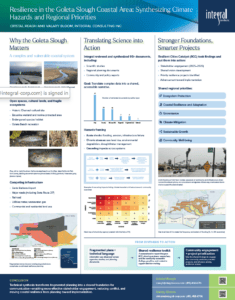
Why the Goleta Slough Matters
A complex and vulnerable coastal system
Open Spaces, Cultural Lands, and Fragile Ecosystems
- Historic Chumash cultural site
- Estuarine wetland and marine protected area
- Endangered species habitat
- Goleta Beach recreation
Competing Infrastructure
- Santa Barbara Airport
- Major roads (including State Route 217)
- Railroad
- Utilities: water, wastewater, gas
- Commercial and residential land use
Fragmented Ownership and Overlapping Jurisdictions
Fragmented ownership and overlapping jurisdictions complicate coordinated resilience planning.
| Landowner | Parcel | Acres |
|---|---|---|
| City of Santa Barbara | Santa Barbara Airport | 462 |
| CA Fish and Wildlife | Goleta Slough Ecological Reserve | 384 |
| County of Santa Barbara | Utilities on County Slough Land | 187 |
| County of Santa Barbara | Goleta Beach | 25 |
| County of Santa Barbara | Goleta Slough Extensions | 19 |
| UCSB Wetlands | Goleta Slough Extensions | 44 |
| City of Goleta | Goleta Slough Extensions | 14 |
Translating Science into Action
Integral reviewed and synthesized 95+ documents, including:
- Scientific studies
- Regional planning documents
- Community and policy reports
Goal: Translate complex data into a shared, accessible narrative.
Number of Reviewed Documents by Author Type
| Author Type | Documents |
|---|---|
| City | 41 |
| County | 19 |
| Site-specific | 18 |
| Regional | 7 |
| Organizational | 7 |
| National | 1 |
Hazards Framing
- Acute shocks: flooding, erosion, infrastructure failure
- Chronic stresses: sea level rise, environmental degradation, drought/water management
- Cascading impacts across systems
Examples of Cascading Impacts
How climate hazards link to infrastructure and community outcomes:
- Closed slough mouth + heavy rainfall → lagoon flooding → runway and terminal inundation, roadway and neighborhood flooding → airport closure, residential damage, inaccessible infrastructure and job centers
- Severe storm event + coastal erosion → impacts to Goleta Beach park amenities and wastewater infrastructure → reduced recreational beach access, ocean pollution, and associated health risks
- Wildfire in foothills + ash slurry to debris flow → sediment blockage in creek channels → flooding of roadways and neighborhoods
Shocks by Agency
Number of times each shock is addressed in each agency’s documents.
| Agency | Flooding: Coastal Wave | Flooding: Fluvial Watershed | Wildfires / Landslides | Flooding: Lagoon | Earthquake / Tsunami / Liquefaction | Extreme Heat / Drought |
|---|---|---|---|---|---|---|
| City of Goleta | 15 | 13 | 12 | 10 | 5 | 4 |
| County of Santa Barbara | 13 | 10 | 8 | 5 | 5 | 4 |
| City of Santa Barbara | 10 | 9 | 6 | 7 | 7 | 2 |
| Santa Barbara Airport | 5 | 5 | 0 | 3 | 0 | 0 |
| UCSB | 2 | 1 | 1 | 1 | 0 | 2 |
Heat map data of shocks by agency (created with the help of AI).
Stronger Foundations, Smarter Projects
Resilient Cities Catalyst (RCC) took the findings and put them into action:
- Stakeholder engagement (2025–2026)
- Shared vision development
- Priority resilience projects identified
- Advancement toward implementation
Shared Regional Priorities
- Ecosystem Protection
- Coastal Resilience and Adaptation
- Governance
- Climate Mitigation
- Sustainable Growth
- Community Well-being
Sea level rise will increase the frequency and extent of flooding in the area under 2-, 4-, and 6-foot scenarios.
From Synthesis to Action
- Fragmented plans + technical language: Information was dispersed across agencies, studies, and planning documents.
- Shared resilience toolkit: A comprehensive report gave RCC, planning partners, researchers, and the community accessible findings, graphics, and context to support decision-making.
- Community engagement + project prioritization: The shared findings are used to engage the community, evaluate potential projects, and advance priority resilience actions.
Conclusion
Technical synthesis transforms fragmented planning into a shared foundation for communication, enabling more effective stakeholder engagement, reducing conflict, and moving coastal resilience from planning toward implementation.
Contact
Cristal Reagh
(415) 458-6713 | creagh@integral-corp.com
Valary Bloom
(415) 458-6706 | vbloom@integral-corp.com