
Presented by David Revell, Ph.D. at ICCE 2026.
INTRODUCTION
Coastal hazards such as erosion, flooding, and infrastructure loss are intensifying along the Pacific coast. Traditional shoreline armoring approaches often conflict with ecological goals and regulatory frameworks (Morris et al., 2018). Nature-based solutions, particularly those integrating driftwood and cobbles, offer sustainable alternatives that better align with geomorphic processes and community values (Arkema et al., 2013; Bilkovic et al., 2017).
METHODOLOGY: A GEOMORPHIC DESIGN FRAMEWORK
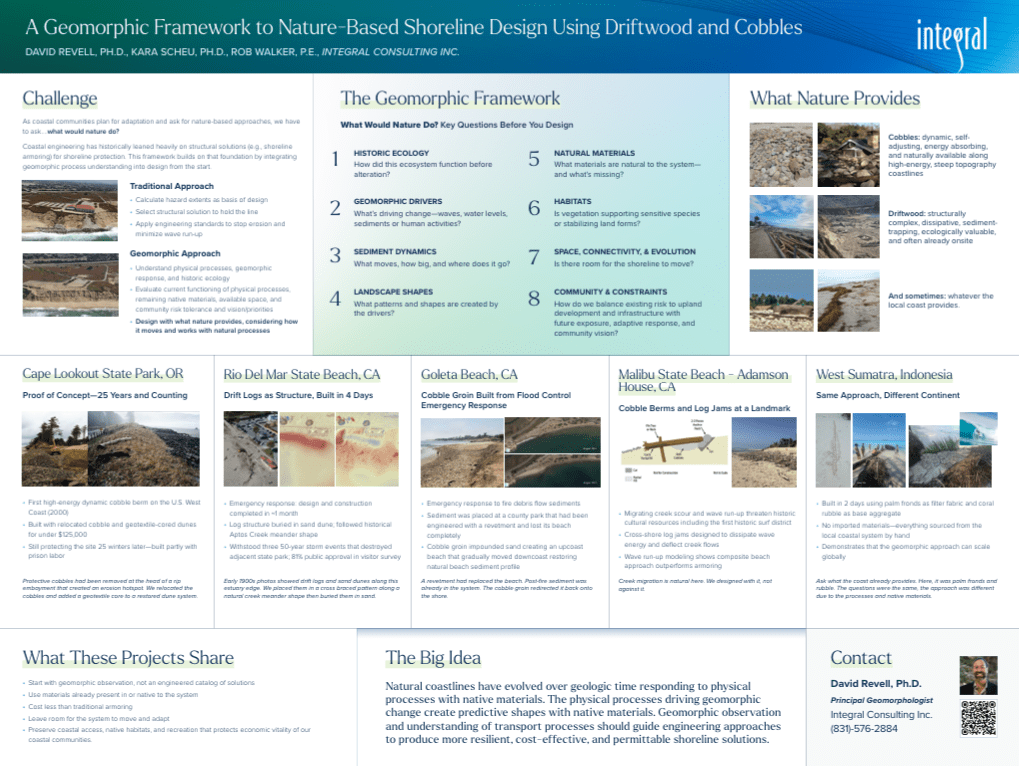
This framework is rooted in geomorphology and historical ecology, emphasizing a deep understanding of the physical processes and natural materials that shaped historic ecosystems. Key steps and guiding questions include:
- Understanding the natural system: How did the site function before alteration?
- Identifying erosion drivers: What coastal processes are causing erosion – waves, water levels, or human activities?
- Assessing sediment dynamics: What sediments are in the system? Consider grain size, transport mechanisms, seasonal variability, or episodic inputs.
- Evaluating natural materials: How available is driftwood, cobbles, and sand? What is missing and/or needed?
- Considering vegetation-sediment feedbacks: Does existing vegetation support sensitive species or stabilize habitats?
- Assessing space, connectivity and evolution: Is there room for landward migration or connectivity among habitats to accommodate dynamic future changes?
- Balancing community goals and regulatory constraints: How do designs reconcile risk tolerance with regulations and resource values?
CASE STUDIES
Four cases studies demonstrate how a geomorphic design framework – mimicking nature by designing with natural processes using native materials – can stabilize shorelines, reduce erosion, enhance resilience, and maintain ecological and recreational functions, many of them built at low cost.
Cape Lookout, Oregon:
The first high-energy dynamic cobble berm revetment on the U.S. West Coast. Constructed in 2000 using relocated cobble deposits and geotextile-cored dunes, it was recently identified as a top tier example of a successful design with cobble slopes 5H:1V and crest elevations 5.8–7.8 m MLLW. The fact that this low cost (less than $125,000) pilot project built using prison labor is still reducing erosion after 25 years showcases that natural approaches can buy time for communities and memories to evolve at lower cost. (Revell et al., 2002; Allan and Komar, 2004; Bond et al 2025).
Rio Del Mar, California:
Engineered cross-braced log walls buried in a sand dune protected a State Park restroom and critical wastewater pump station from erosion during three ~50-year storm wave events within 4 years of construction. The integration of large wood into the core of the dune improved sediment retention and provided low-cost (<$100,000) erosion protection while nearby portions of the same park were severely eroded (Figure 1; Integral Consulting, 2020). Project design and construction occurred in about 1 month under emergency permits with full permits waived.

Ecola Creek, Oregon:
An estuary shoreline influenced by fluvial and coastal processes shows erosion (~1m/year) that threatens development, infrastructure and public access. Modeling identified wave action during king tides as the primary erosion driver. A proposed hybrid design using cross-braced driftwood, cobbles, and capped in a vegetated dune maintains coastal access and reduces shoreline erosion using natural materials found onsite. Geotechnical investigations found a natural analog about 35m upstream (Figure 2).

Malibu Surfrider / Adamson House, California:
Migrating creek scour and subsequent wave run-up threaten a national historic landmark. This living shoreline integrates a geomorphic evaluation of creek scour depths and inlet dynamics with a design incorporating cobble berms and cross-shore log jams to dissipate wave energy, retain sediment and deflect creek flows (Figure 3). Wave run-up modeling indicates the composite beach design will significantly reduce wave run-up compared to armored or sand-only approaches (Ellenson et al., 2023). This living shoreline design balances native sediment augmentation and dune habitat restoration with access and recreation to protect historic cultural resources.

CONCLUSION
These case studies demonstrate the potential for scalable nature-based approaches across diverse high wave energy coastal settings. By mimicking natural processes and using locally available materials, these low-cost designs have reduced storm damage and provided time for communities to plan long-term adaptation strategies.
Dynamic cobble berm revetments replicate composite beaches with sandy foreshores and steep cobble berms. Key design parameters include cobble size, gradation, crest elevation and width, slope (5H:1V typical), and toe elevation. Angular cobbles interlock better, reduce sand erosion, and allow crest growth; rounded cobbles are more mobile. The use of logs in the design can enhance erosion protection and increase sediment retention, which leads to reduced maintenance costs. Adaptive management and monitoring are essential to maintaining project performance.
Integrating a geomorphic framework into the engineering design of nature-based living shorelines improves the resiliency of the projects. The success of these designs illustrates how driftwood and cobbles can be used to create resilient, nature-based protection for both people and ecosystems. Driftwood and cobbles, when used strategically, can mimic natural processes, reduce erosion, and support ecological and community goals. Ultimately this integration leads to the creation of adaptive, resilient, and more permittable shoreline solutions.
REFERENCES
Allan and Komar (2004): Environmentally compatible cobble berm and artificial dune for shore protection. Shore & Beach, 72(1), 9-18.
Arkema et al. (2013): Coastal habitats shield people and property from sea-level rise and storms. Nature Climate Change, 3(10), 913-918.
Bilkovic, et al. (2017): Living Shorelines: Science and Management of Nature-Based Coastal Protection. CRC Press.
Blenkinsopp, et al. (2022). Wave runup on composite beaches and dynamic cobble berm revetments. Coastal Engineering, page 104-148.
Bond, et al. (2025): Dynamic cobble berm revetments: the state of the practice and a proposed design process. Frontiers in Marine Science, 12:1603318.
Ellenson, Revell, Jamieson, Blakesley. (2023): Influence of living shoreline elements on wave run-up elevations. Shore & Beach, 91(2), 30-37.
Integral Consulting Inc. (2020): Adamson House Living Shoreline Erosion Mitigation and Basis of Design Memo.
Komar and Allan. (2010): Design with nature strategies for shore protection. USGS Scientific Investigations Report 2010-5254.
Morris, et al. (2018): From grey to green: Efficacy of eco-engineering solutions for nature-based coastal defense. Global Change Biology, 24(5), 1827-1842.
Revell, Komar, & Sallenger. (2002): An application of LiDAR to analyses of El Niño erosion in the Netarts littoral cell, Oregon. Journal of Coastal Research, 18(4), 792–801.