
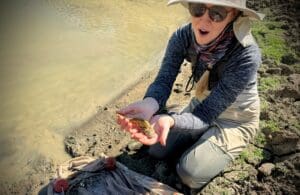
Some days start before sunrise for Lauren Salazar. She is already in the field, scanning treetops for nesting birds or wading into a mitigation pond to dip-net for California red-legged frogs and California tiger salamander larvae. By afternoon, she might be at her desk reviewing survey results and writing technical reports. Ask her what a typical day looks like, and she’ll tell you: there isn’t one.
“That’s one thing I love about the job,” she says. “It’s very exciting. It never becomes mundane. Every day is different and you’re working with multiple species in a variety of locations.”
No two days are the same
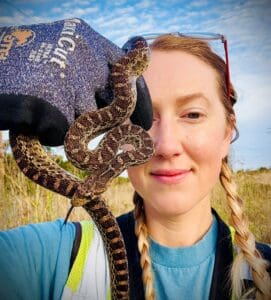
Lauren is a wildlife ecologist, and her work spans a wide range of tasks: nesting bird and raptor surveys, mist-netting bats, monitoring construction sites, and assessing habitats. The mix of desk- and fieldwork changes with the seasons. Fieldwork can make up nearly all of her week during nesting bird season, and far less in the slower winter months.
Lauren’s projects take her across the San Francisco Bay Area and California’s Central Valley, occasionally as far as Arizona for bat surveys, and through a range of habitats. “One day I may work at a construction site, and the next I may be at a wetland, a river corridor, an airfield, or an open space preserve,” she says.
Ask her to describe her job in one sentence, and she has a favorite: “I’m the Lorax, I speak for the trees. But actually, I speak for the wildlife.”
When expertise protects both wildlife and the project
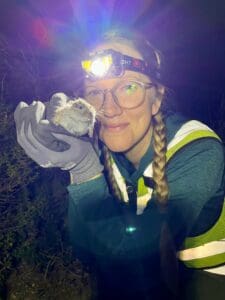
That line is more than a joke. Lauren’s observations regularly impact what happens on a project site. She’s paused tree removal after finding an active bird nest overhead, protected a family of Bewick’s wrens nesting in a light post slated for removal, and flagged a red-tailed hawk nest near planned tree work, prompting the addition of a buffer to protect the nest from failing due to nearby disturbance.
When asked which moment captures what it’s like to work in this field, Lauren doesn’t point to a single project. It’s something more constant: the ability to act on what she observes. “I’m encouraged to look for what’s actually present. If I find something unusual at a project site, that’s celebrated, not discouraged.” For a wildlife ecologist, that matters. Her job depends on accuracy, and knowing her observations are trusted is part of what makes her confident in the work she does every day.
When a survey turns up something like an active bird nest, Lauren reports it even if it means pausing part of a project. In her experience, contractors take it in stride once she explains what’s at stake, such as one adult and four nestlings, not just “one bird.” Most already know the regulations protecting these species and want to stay in compliance just as much as she does. “I love going home on days like that,” she says, “knowing I saved an entire nest.”
Different disciplines, one team
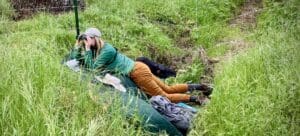
Environmental consulting is inherently collaborative and Lauren’s day-to-day reflects that. A single project might involve restoration and wildlife ecologists, botanists, GIS professionals, project managers, planners, contractors, and clients, all sharing information and reviewing each other’s work.
“Just yesterday, I went out in the field with our botany team,” she says. “They mapped habitats and did a full plant species list while I conducted wildlife surveys alongside them. If they walk ahead and spot something, like a woodrat nest, they’ll point it out. I can help with plant identification too, since I have a background in botany.”
Sometimes teamwork looks even more literal. “I’ve had a coworker pull me out of a mud pond I got stuck in,” Lauren laughs. “That’s another form of teamwork in the field.”
What stands out most to Lauren is the openness among colleagues. “This work brings together people with different specialties and backgrounds. There’s always information someone knows that someone else doesn’t, and everyone is willing to share. There’s no gatekeeping.”
That same spirit shows how her team supports her growth. She credits her supervisor: “He’s always helping me figure out how I can get more learning experience and expand my skill set.” For Lauren, a self-described lifelong learner, that culture of continual learning is what stands out most about the field itself. There’s always a new species, a new habitat, or something to learn from a colleague in another discipline.
She also points to the flexibility that’s allowed her to shape her work around what matters most outside the office. Combined with the support of her team, it has helped her build a career that works alongside the rest of her life.
What she’d tell someone who is considering this path
Lauren didn’t know her job existed until she had it. “If I had known in college, I would have pursued it a lot earlier,” she says. Now, more than 5 years into her career in environmental consulting, she describes it simply: “This is my dream job.”
Her advice is: be comfortable working both independently in the field and collaboratively in the office. You have to be willing to continually learn, because there are always new species, regulations, and challenges to understand. But if you enjoy being outdoors, solving problems, and seeing your work applied to real-world projects, it can be an incredibly rewarding career.
Interested in a career where your work can directly shape real-world outcomes? Explore open roles at Integral.