
Using an Agent-Based Model to Estimate Effects of EMF Exposure from Offshore Wind Infrastructure on Benthic Marine Organisms
Project Summary
Offshore wind developers need to understand potential impacts of electromagnetic fields (EMF) generated by offshore infrastructure on benthic marine organisms. Integral developed an innovative Agent-Based Model (ABM) to evaluate EMF exposure effects on sensitive species, providing more nuanced risk assessment than traditional threshold methods.
Key Personnel
Dan Dawson, Ph.D., CSE Senior Scientist
Damian V. Preziosi Managing Principal, Strategic Initiatives Director
Conner Schultz Senior Scientist
Challenge
Offshore wind infrastructure generates electric and magnetic fields that may affect benthic organisms nearby, but traditional threshold assessments might be overly conservative.
Offshore wind infrastructure generates electric and magnetic fields (EMF) that may affect benthic organisms nearby. Potential EMF risks to species are usually assessed using threshold methods comparing project EMF outputs with exposure experiments. Threshold assessments might be overly conservative, as most observed EMF effects are short-term behavioral changes and potentially not impactful at a population level.
Offshore wind developers face uncertainty in environmental impact assessments because:
- Most observed EMF effects in laboratory studies were short-term behavioral changes potentially not impactful at a population level
- Traditional threshold methods comparing project EMF outputs with exposure experiments provided limited ecological context
- Existing assessment approaches couldn’t relate EMF exposure to ecologically meaningful effects or population-level impacts
Our Role
Integral developed an Agent-Based Model to evaluate effects of EMF exposure using little skate as a test case, linking exposure to biologically meaningful effects through bioenergetics modeling.
We created an ABM using NetLogo 3D that could simulate individual skate movements and behaviors in response to EMF fields from buried cables.
The model integrated multiple sub-models to capture:
- Skate activity patterns (exploring and resting behaviors)
- Movements (moving, turning, rising/sinking)
- Energetics calculations (energy per km/hr traveled)
- EMF (emitted by two cables buried below seafloor; DC magnetic field flux (mG) using Biot-Savart Law equation
- EMF exposure (passive uptake of EMF by skates)
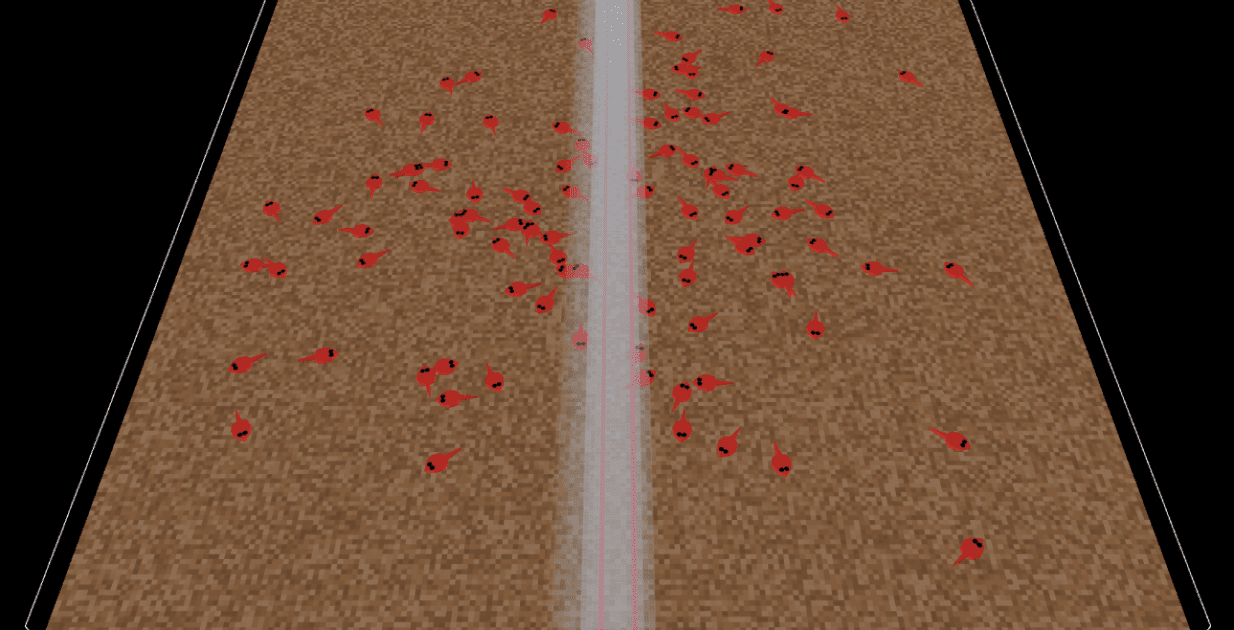
The NetLogo model world. Features include two buried cables (represented by red bars) running along the seafloor, the EMF field (shown as a translucent zone) from the cables, and skates (shown as red fish)
What We Delivered
We delivered a proof-of-concept application that simulated skate population movements over 24-hour periods across multiple cable amperage scenarios.
Our team provided:
- A fully functional Agent-Based Model built in NetLogo 3D (v.6.3) simulating a 0.25 km² area
- Model world with 200 x 200 x 9 cell depth representing approximately 2.5m per cell
- Simulation of two buried cables running along the seafloor with EMF field visualization
- Integration of published research on skate movement patterns and energetics
- 24-hour simulation runs comparing energy use, distance traveled, and turn frequency to cumulative exposure
- Analysis across multiple cable amperage scenarios to understand dose-response relationships
The model incorporated mechanistic interactions of individual skates with their environment, allowing population-level effects to emerge from individual behavioral responses to EMF exposure.
The Result
The ABM demonstrated that while EMF exposure increases with cable amperage, population-level effects may be limited due to minor impacts on energetics and the spatially restricted nature of high-exposure zones.
Key findings from the modeling effort:
- As cable amperage rises, exposure to EMF increases; however, its effect on populations may be limited due to very minor impacts
- The region with high EMF exposure is limited, covering only about 10% of 0.25 km²
- Slight increases in average energy costs occurred with increasing amperage, driven by marginally higher mean travel distances
- EMF effects on energetics needs further consideration
- Even if effects aren’t dramatic, the model provided more detailed information than previous simple threshold assessments.
This approach positions offshore infrastructure stakeholders to address regulatory concerns with sophisticated, biologically relevant assessments rather than overly conservative threshold comparisons. Next steps identified include modeling potential changes in swimming efficiency and foraging success, evaluating population-level impacts, and repeating the process for American lobster.