SEDFlume

Quantify your site’s sediment mobility with SEDflume.

When sediment stability determines project success, assumptions aren’t enough. Our SEDflume laboratory provides direct erosion measurements that inform confident decisions for remedial design, dredging operations, and habitat restoration. Working across coastal, estuarine, and riverine systems worldwide, we deliver site-specific data that moves your project forward with regulatory confidence.

Key Contacts

Craig A. Jones, Ph.D. Managing Principal, Business Director - Marine, Coastal, Climate, and Technology Services

Bio

Samuel McWilliams, E.I.T. Senior Consultant, Practice Director - Marine Science and Engineering

Bio

The System

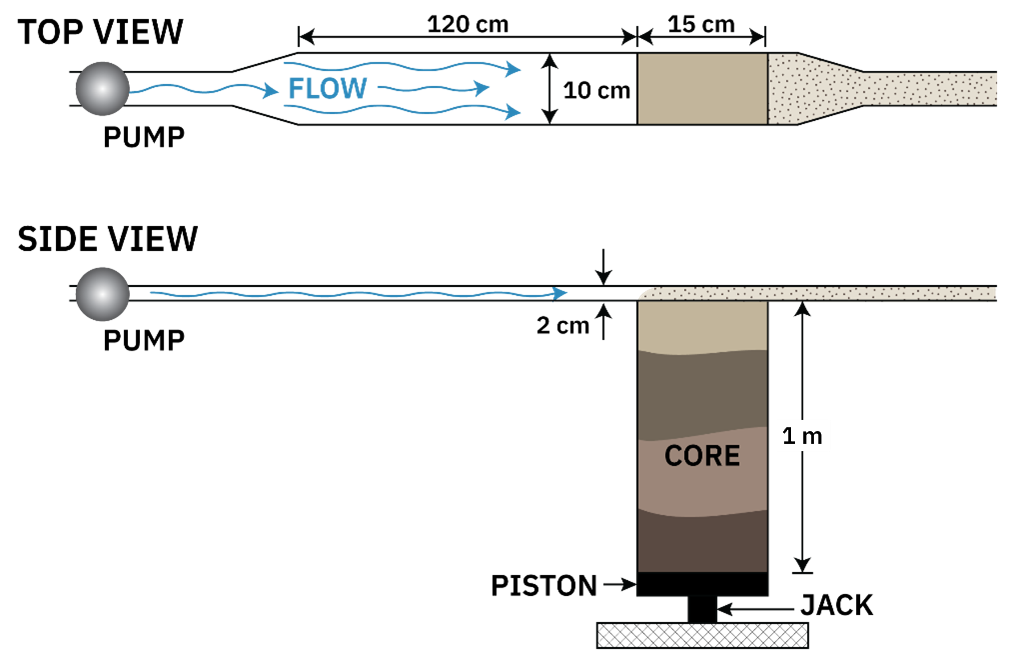
SEDflume is a tool to determine erosion rates of bedded sediment. SEDflume addresses deficiencies in the analytical or empirical characterization of cohesive sediment erosion rates by providing direct measurements. SEDflume studies produce measurements of erosion rates, derived critical shear stresses for erosion, and measurements of grain size distribution and bulk densities at multiple depth intervals in a sample.

How It Works

The SEDflume consists of a narrow channel 2 cm thick and 10 cm wide that directs constant rates of water over the sediment surface. When the applied force due to the flow results in sediment erosion, the core is extruded to maintain a consistent surface elevation. After 10 minutes, the amount of extrusion is recorded and the flowrate is increased. Applied shear stresses range from 0.1 to 12.8 pascals (Pa).

Capabilities

  • Erosion and critical shear stress profiles with depth.
  • Erosion and critical shear stress measurements at high shear stresses (greater than 10 Pa).
  • Direct quantification of particle size distribution, density, and loss on ignition for maximum data correlation.

Applications

  • Direct determination of erosion potential of cohesive and noncohesive sediments.
  • Unique data for use in engineering and environmental studies of sediment stability.
  • Quantitative evaluation of capping material effectiveness.
  • Evaluation of dredge material stability.

Sheer Stress and Erosion

For a robust description of the sediment bed, critical shear stress and erosion rates can be correlated with measurements of particle size distribution, bulk density, or other geotechnical parameters. Results can be used to compare disparate areas and depths within the system to determine more or less erodible areas relative to a site average.

In The Field

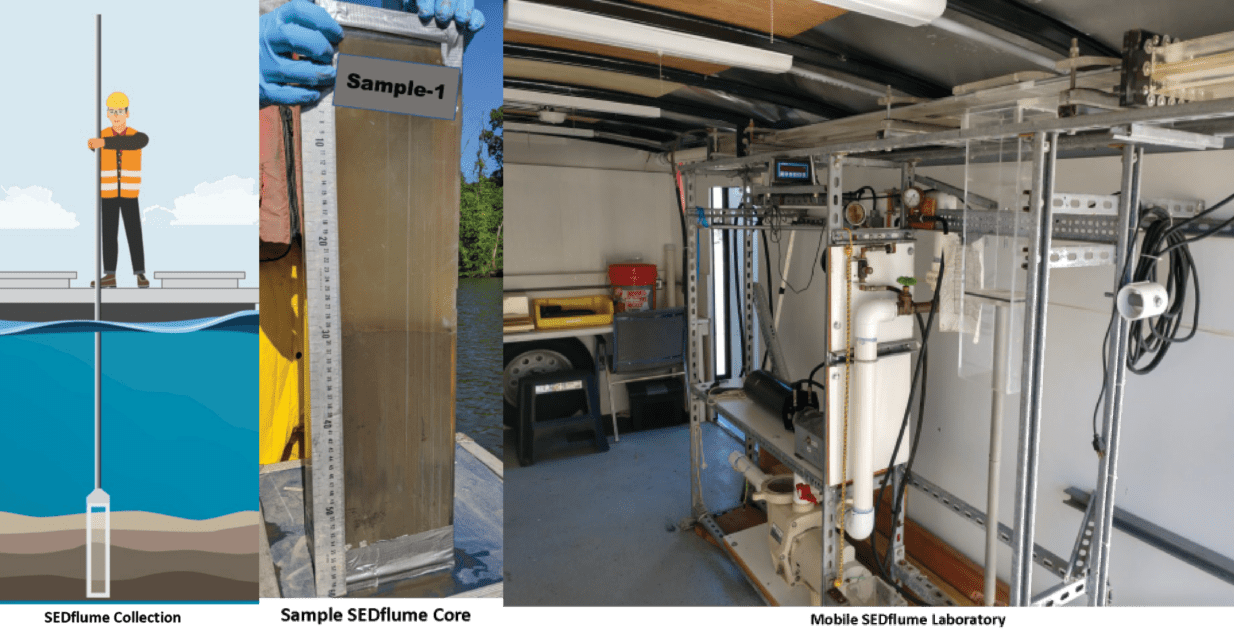
SEDflume samples are collected using a push core to limit sediment disturbance. Samples are collected, cataloged, and securely stored for transport to Integral’s SEDflume laboratory in Santa Cruz, California, or the mobile SEDflume lab for onsite analysis.
  • For SEDflume sample collection, a push core is inserted into the sediment bed with minimal disturbance and recovers up to 45 cm of sediment
  • Sample SEDflume cores collected in the field are packaged watertight for transport
  • Samples are analyzed at Integral’s SEDflume laboratory shown in Santa Cruz or can be handled using the mobile SEDflume laboratory in the photo above.

Example Results

SEDflume core and its measure erosion rates

Sediment particle size distribution relative to depth. Measured using laser diffraction.

Project Highlights

Berry's Creek, New Jersey
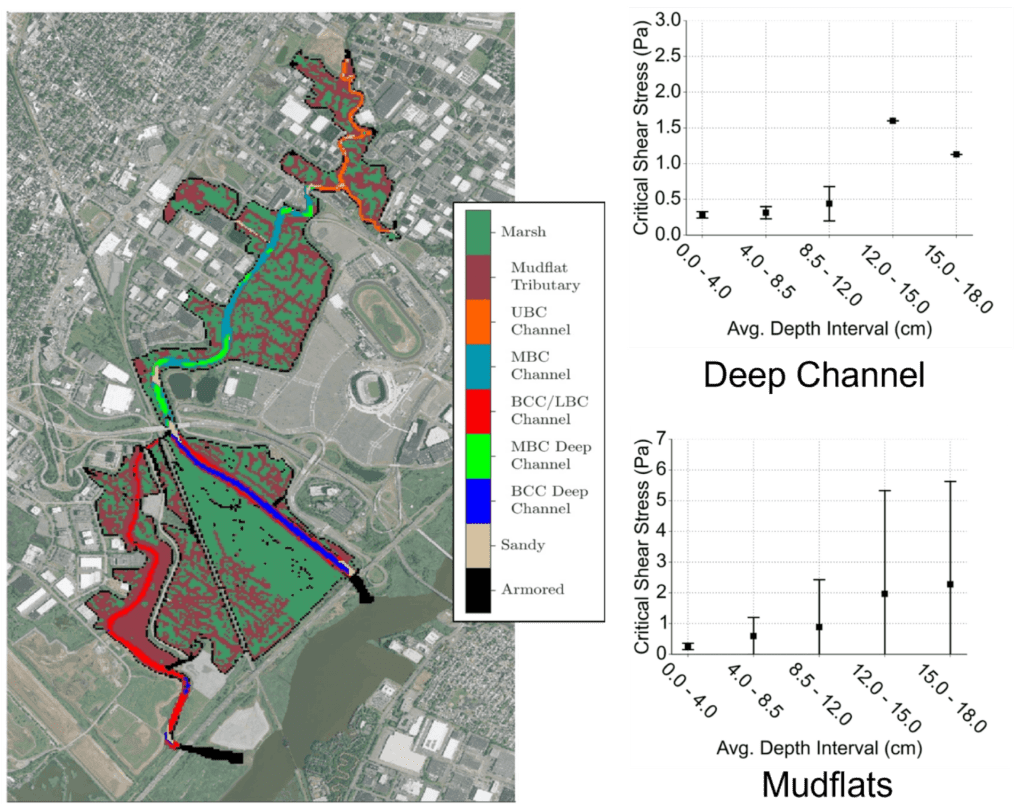
The remedial investigation and feasibility study of the Berry’s Creek Study Area utilized SEDflume to quantify erodibility parameters of different morphologic types throughout the site. Data from the SEDflume studies supported the development and application of numerical models of sediment fate and transport. Read full case study.

South San Francisco Bay

Intertidal flats provide important, and sometimes critical, habitats for benthic communities, fish, birds, and mammals in San Francisco Bay. Additionally, intertidal flats can act as reservoirs for sediment-bound contaminants from both historical and ongoing sources. The dual role of intertidal flats in critical habitat and as a potential reservoir for contamination may cause unacceptable ecosystem and human health risks. Development of a deeper understanding of the processes governing the morphology and character of the intertidal flats through the use of SEDflume has been critical for effective restoration of habitat and reduction of potential ecosystem and human health risks.